Headline: Bayern Munich and Borussia Dortmund: The Evolution of a Rivalry
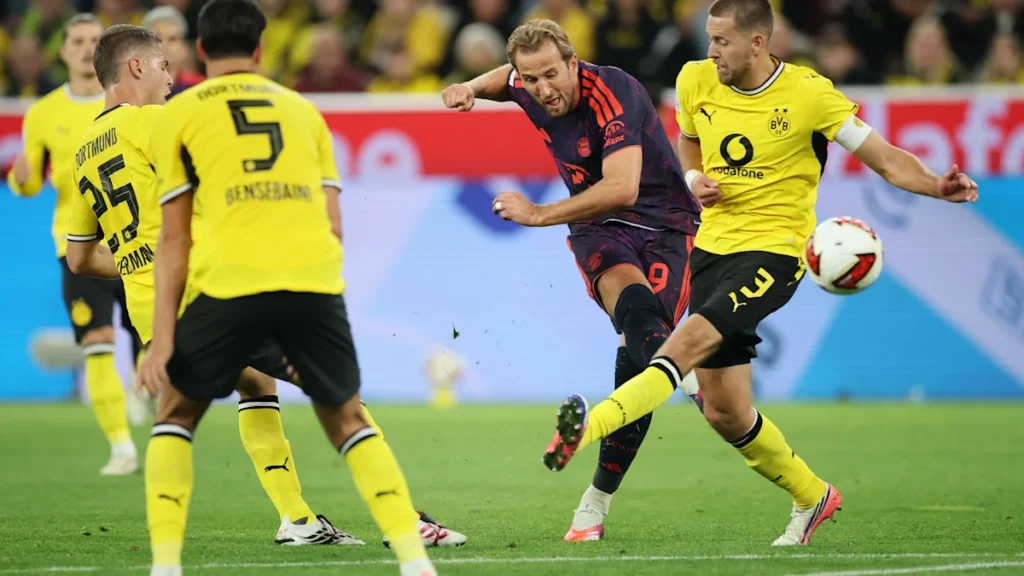
Few fixtures in German football have transformed like Bayern Munich against Borussia Dortmund. Today, Der Klassiker is promoted as the Bundesliga’s premier attraction, uniting two of Germany’s most recognizable clubs in a match followed by millions globally.
However, the rivalry experienced by fans in the early 2000s differs significantly from the spectacle presented in 2026.
Advertisement
At that time, Bayern and Dortmund were already major competitors, yet their encounters were defined more by sporting hostility, distinct club identities, and the fight for domestic supremacy than by the international branding that surrounds the fixture today.
When the rivalry was about more than football
The early 2000s marked one of the fiercest periods in the relationship between the two clubs.
Bayern entered the decade as Germany’s leading force, while Dortmund had already proven their capability to challenge that dominance by winning consecutive Bundesliga titles in 1995 and 1996 and the Champions League in 1997.
Advertisement
Their encounters became increasingly contentious. The notorious 2001 match in Munich, which ended in a 1-1 draw, saw 14 yellow cards and three red cards, showcasing the rivalry’s hostility during that period.
Dortmund’s Bundesliga victory in the 2001/02 season affirmed their position as serious contenders, but financial troubles soon altered the club’s trajectory.
While Bayern continued to secure domestic titles, Dortmund spent years in rebuilding mode. Although the rivalry remained historically significant, it was no longer marked by direct confrontations between two title contenders.
Klopp transformed Der Klassiker
Everything shifted with Jürgen Klopp’s arrival at Dortmund in 2008.
Advertisement
His high-energy, pressing style converted a promising squad into one of Europe’s most exciting teams. Dortmund captured consecutive Bundesliga titles in 2010/11 and 2011/12, along with achieving the domestic double in 2012.
For the first time in years, Bayern faced a rival capable of consistently challenging them, not just over a single match but across an entire season.
The rivalry reached its modern zenith in 2013, when both clubs collided in the UEFA Champions League final at Wembley. Bayern’s 2-1 win, clinched by Arjen Robben’s late goal, symbolized more than just another European trophy.
It underscored that German football had become the focal point of European competition, with two Bundesliga clubs vying for the continent’s most coveted title.
Advertisement
This era also accelerated the transformation of Der Klassiker into a global product.
From sporting rivalry to financial imbalance
In the years following Wembley, the competitive landscape shifted.
Bayern solidified their dominance as Germany’s top club, while Dortmund increasingly became known for developing talented young players only to lose them to wealthier rivals.
The transfers of Mario Götze in 2013 and Robert Lewandowski in 2014 epitomized this trend. Both were central to Dortmund’s achievements under Klopp, yet both ultimately moved to Bayern.
For Dortmund supporters, these departures amplified the challenges of competing against a club with far greater financial clout. For Bayern, they illustrated the club’s capacity to attract elite talent while maintaining dominance domestically.
Advertisement
Between 2013 and 2023, Bayern captured 11 successive Bundesliga titles. Although Dortmund remained competitive, occasionally narrowing the title race, they struggled to maintain the consistency necessary to surpass their rivals.
What Der Klassiker represents in 2026
By 2026, the fixture has transformed into something significantly different from the confrontations of the early 2000s.
Bayern’s attacking style under Vincent Kompany, featuring players like Harry Kane, Michael Olise, and Luis Díaz, showcases the club’s ongoing ability to attract prestigious international talent. Conversely, Dortmund continues to blend ambitious recruitment with player development under Niko Kovač.
Advertisement
The forthcoming meeting at the Allianz Arena on 31 October presents an intriguing chapter. Both teams enter Matchday 8 unbeaten and tied on 17 points, with Bayern leading based on goal difference.
However, the most significant change is not so much tactical or financial but rather how the fixture is perceived.
What was once primarily a fiercely contested domestic clash has morphed into a global television event, capturing audiences far beyond Germany.
This international spotlight has unquestionably benefited the Bundesliga, but it has also established expectations that every matchup should symbolize a decisive battle for the title.
Advertisement
In reality, that has not always been the case.
Has Der Klassiker lost some of its original identity?
Some argue that Der Klassiker has fallen victim to its own commercial success.
The rivalry remains fierce, and victories continue to hold immense significance for supporters. Yet, the encounters of the early 2000s boasted a different vibe, where physical confrontations, bold personalities, and genuine animosity often took precedence over the game itself.
Klopp’s Dortmund then elevated the competition to new heights, challenging Bayern both domestically and internationally.
Advertisement
Today, the rivalry is more polished, marketable, and accessible to international viewers. However, the competitive imbalance of recent years has complicated efforts to recapture the uncertainty that defined its most celebrated moments.
This does not imply Der Klassiker has lost its significance.
Instead, it has evolved alongside German football, transforming from an intense local rivalry into the Bundesliga’s most recognizable international fixture.
The challenge for the years ahead is to ensure the sporting competition remains as captivating as the spectacle that surrounds it.
Advertisement
Because what made Bayern against Dortmund truly special was never just the name Der Klassiker; it was the underlying tension that either team could earnestly contest for the biggest accolades in German football.