Arsenal Displays Resilience in 1-1 Draw Against Barcelona in UEFA Women’s Champions League
A 1-1 draw against Barcelona in the UEFA Women’s Champions League proved so much more for a renewed Arsenal side. It showed a glimpse of their potential to adapt, sustain pressure and find a different way to compete.
After a difficult run of domestic performances, Renée Slegers’ side travelled to Camp Nou knowing they would have to withstand long spells without the ball. They did exactly that, even if the final result left a sense of what might have been.
Advertisement
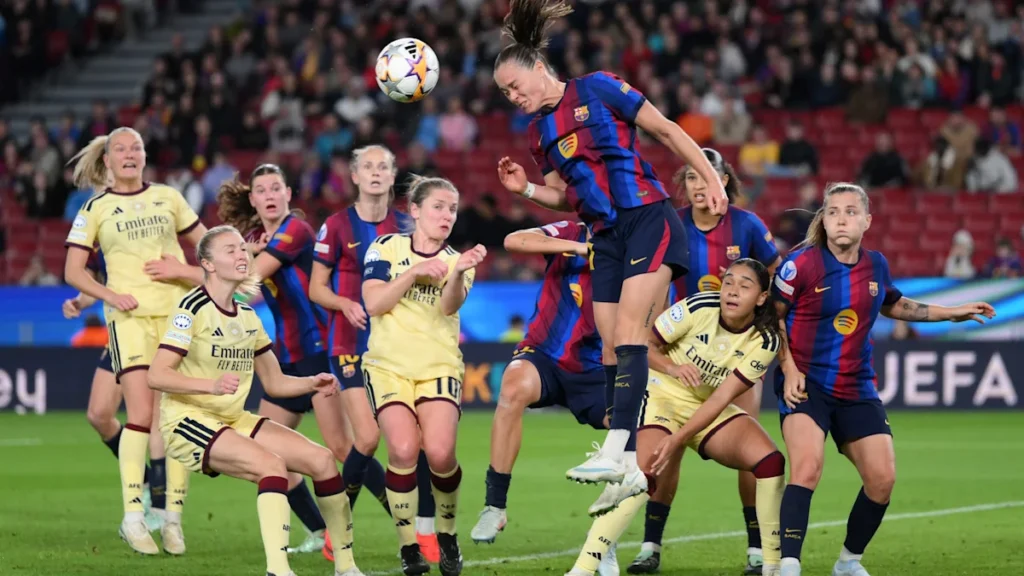
Frida Maanum put Arsenal ahead in the 22nd minute, while Caroline Graham Hansen restored parity after the break. Barcelona dominated possession and created more chances, but Arsenal’s resilience and Misa Rodríguez’s goalkeeping gave them a platform to take something away from one of their toughest away fixtures.
A Different Arsenal at Camp Nou
For much of the opening half hour, Arsenal were made to work without the ball. Barcelona controlled the tempo and dominated possession, repeatedly finding gaps around the visitors’ defensive structure.
Misa Rodríguez was called into action almost immediately. Graham Hansen tested her early in the seventh minute, forcing the Spanish keeper to tip the ball over. Moments later, Sydney Schertenleib broke through on goal, and Rodríguez bravely took a shot straight to the face to keep it out.
Advertisement
It was a painful start, but a crucial one. Barcelona kept pushing forward, with Esmee Brugts and Schertenleib both finding pockets of space near the Arsenal box. Misa refused to fold, pulling off an incredible double save just as Barcelona looked ready to take over the game.
Playing against one of her old club’s biggest rivals, she gave Arsenal exactly what they needed: a calm head and the grit to keep them in the fight.
It wasn’t a completely smooth night. Just before the hour mark, a stray pass from Rodríguez handed Barcelona another chance to attack and her rushed clearance only made things worse.
Advertisement
Even so, her early heroics made all the difference. Without those big stops, Arsenal would have been left with an uphill battle they wouldn’t survive.
Frida Maanum Gives Arsenal Something to Hold On To
With Barcelona controlling so much of the ball, Arsenal’s opening goal seemingly came out of nowhere.
Alessia Russo sparked the move, putting in great work down the left wing before carving out enough room to whip a cross into the box. Caitlin Foord got on the end of it, only to see her close-range shot denied by Cata Coll. The loose ball bounced right to Frida Maanum, who reacted fastest to smash Arsenal into a 22nd-minute lead.
Advertisement
Arsenal had struggled to get a foothold in Barcelona’s half, yet Russo’s moment of magic created something out of nothing.
That goal completely shifted the mood of the match. Arsenal dropped deeper, packing players behind the ball. Barcelona kept coming at them, but the Gunners were more than willing to turn the game into a scrap.
It wasn’t always pretty. Barcelona still found gaps through the middle and out wide, while Arsenal scrambled to clear their lines. Their backline looked stretched at times as the hosts swung the ball from side to side.
Even under all that pressure, Arsenal stuck to their game plan.
Advertisement
Caroline Graham Hansen Finds the Answer for Barcelona
The pressure eventually told.
Barcelona introduced Aitana Bonmatí shortly before the hour mark, the first of two three-time Ballon d’Or winners Arsenal face this week. Three minutes later, the hosts found their equaliser.
Brugts picked out Graham Hansen on the right. The Norwegian winger cut inside, created enough separation from the Arsenal defenders and curled a finish beyond Rodríguez into the far corner.
Going into this matchup, Arsenal would have known the individual quality they were dealing with. Graham Hansen did not need much space to make the difference, and the defensive organization that had protected Arsenal for much of the match was briefly undone.
Advertisement
There was a clear opportunity for Arsenal to manage the danger better. Graham Hansen had too much room to work with, and the visitors were unable to close the space quickly enough.
The equaliser gave Barcelona renewed momentum, but it also appeared to change the rhythm of the match.
Arsenal began finding more opportunities to move forward rather than simply clearing their lines. Slegers introduced former Barcelona defender Ona Batlle and Olivia Smith, while later changes helped refresh the midfield and attacking options.
Maanum came close to adding a second when she raced towards goal, only for Coll to intervene.
Advertisement
The final stages were tense. Barcelona continued to search for a winner, while Arsenal had to defend just as they would’ve in the 2025 final. Neither side found another breakthrough, and the points were shared.
A Response to Arsenal’s Domestic Struggles
Arguably, the most interesting part of this performance was how different Arsenal looked compared with some of their recent WSL outings.
The Gunners have struggled domestically. Draws against Aston Villa and Birmingham City, a frustrating stalemate with Manchester United and defeats to Chelsea and Manchester City have left them playing catch-up in the league. Even their recent 2-1 victory over Liverpool highlighted some of the inconsistencies that have followed them through the opening months of the campaign.
Advertisement
There has been a recurring problem with translating possession and attacking quality into convincing performances. Arsenal have oftentimes looked predictable, struggled to break down compact defences and left themselves vulnerable when opponents transition quickly.
Against Barcelona, however, Slegers did not ask her players to dominate the ball or force their usual attacking patterns. Instead, Arsenal accepted that they would have to defend for long periods.
The numbers tell the story. Barcelona finished with approximately 70 percent possession, while Arsenal managed just 30 percent. Yet the visitors found ways to threaten on the counter.
That is an important distinction. Arsenal did not suddenly solve all their problems, nor was this a performance without defensive weaknesses. Barcelona created enough opportunities to win comfortably on another evening. The Gunners simply showed a different approach to adapt rather than insist on playing the way they have been all season long.
Advertisement
Misa Rodríguez Makes Her Case
Rodríguez deserves particular recognition for the role she played in securing the point.
Her performance was more than just the number of saves. The timing of them was essential. Barcelona threatened early, and she repeatedly denied the hosts when Arsenal were struggling to establish control.
Her familiarity with Spanish football and many of Barcelona’s players clearly played to her strengths. Having spent years at Real Madrid, she understands the intensity and technical demands of this rivalry.
Her arrival at Arsenal also represented a significant addition to the goalkeeping department. With Daphne van Domselaar and Anneke Borbe providing competition, Rodríguez has joined a squad with considerable depth in that position.
Advertisement
This was an opportunity to demonstrate why Arsenal brought her to London. Despite the mistake in possession, she responded with composure and made several interventions that kept the visitors alive in what may have looked to be an otherwise silencing blow.
Two Very Different Tests Await for Arsenal
Arsenal cannot afford to spend too long moping about the result. Their next two fixtures offer very different challenges about whether this performance represents a genuine turning point.
First up is London City Lionesses on November 15 in the WSL at Emirates Stadium.
Eder Maestre’s side have ambitions of establishing themselves among the league’s leading clubs and the fixture presents an interesting tactical challenge. Arsenal will likely be expected to take greater responsibility for possession and dictate the attacking tempo.
Advertisement
Four days later, Arsenal return to European action against OL Lyonnes on November 19.
The Lyon fixture will provide another examination of Arsenal’s ability to compete against Europe’s elite. Lyon have the attacking quality to prey on the defensive lapses that Arsenal have found themselves repeatedly creating this season.
The Gunners will need more than resilience. They will need sharper decision-making in possession, better control of transitions and greater efficiency in front of goal.
The draw at Camp Nou was not perfect, and it should not disguise the work still required in the WSL. Yet, it was an encouraging response from a side that has been searching for something concrete.
Advertisement
Most importantly, Arsenal showed they do not always need to dictate a game to compete in it.
That may prove just as important as the point itself.
Related articles from Her Football Hub:
-
Chelsea stars Hannah Hampton and Manaka Matsukubo recognised in Guinness World Records
-
UWCL: Aoba Fujino shines as Man City take 3 points against Inter Milan
-
Iceland international Dagný Brynjarsdóttir announces retirement after 29-year football career