
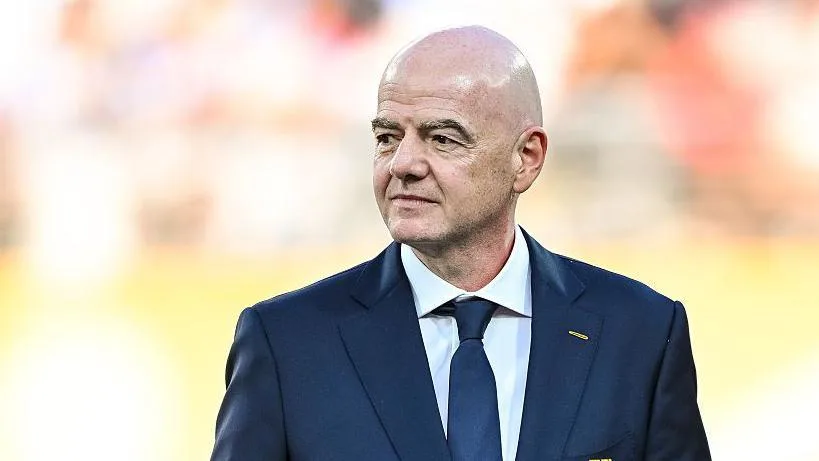
Uefa and European Teams Consider Boycott Over Infantino’s Leadership
European teams may still boycott competitions like the World Cup as Uefa states that Fifa’s defense of its president, Gianni Infantino, “changes nothing.”
In response to the proposal to sell stakes in the World Cup to private investors, the English FA has sent a letter withdrawing its support for Infantino.
Advertisement
Uefa issued a statement declaring that its conditions had not been met, even though Infantino’s plan was ultimately aborted.
“First, the proposals to sell off the major competitions had to be withdrawn, and secondly, assurances must be made that such attempts to disfigure the game in this way will never be made again,” the statement emphasized.
“These conditions have not been met.”
Uefa has already expressed a loss of confidence in Infantino, condemning the Fifa Forward Enterprise (FFE) proposal as a “shabby, back room, opaque deal.”
Infantino had offered all associations $40 million (£30 million) in exchange for their support of the private investment proposal affecting both the men’s and women’s World Cups through the FFE subsidiary.
Advertisement
During a Wednesday meeting, Fifa acknowledged “mistakes” regarding FFE, stating that it was “not the intention” for the Fifa Council and member associations to feel excluded from the process, adding that the handling of the matter should have been different.
Uefa reiterated in its statement: “Uefa made it abundantly clear in its statement on Saturday that it has lost confidence in Gianni Infantino’s presidency. That position holds.”
“Yesterday’s announcement that some people employed by the Fifa president (and whose careers depend on his favour) agree with him changes nothing.”
Fifa has been approached for comment.
Advertisement
Uefa Unimpressed by Fifa’s Statement
Infantino arrived at Fifa’s offices in Rabat, Morocco, on Wednesday in familiar fashion, riding in a motorcade within a blacked-out Mercedes.
Some questioned whether he would remain president upon leaving the building.
However, Infantino seemed more emboldened as he summoned members of the Fifa management board for discussions about recent events.
Advertisement
Secretary general Mattias Grafstrom, often regarded as Infantino’s right-hand man, had previously criticized the FFE proposals in an internal memo, labeling them “a sad and reproachable series of events.”
After the meeting, Infantino and Grafstrom were seen seated together and smiling at a women’s Africa Cup of Nations match between Malawi and Zambia.
If the meeting aimed to clear the air, it appeared to be successful.
Other management board members present included finance chief Thomas Peyer, legal chief Emilio Garcia Silvero, chief of staff Daniel O’Toole, chief of member associations Elkhan Mammadov, and media relations director Bryan Swanson.
Advertisement
BBC Sport has been informed that Fifa’s chief operating officer, Kevin Lamour, was not invited to the meeting.
Lamour had sharply criticized Infantino’s plan, suggesting that it was “the project of one person,” and emphasized the need for football’s leaders to make the right decisions. He remarked, “If I lose my job, then so be it. At least I’ll sleep well tonight.”
Lamour has since declined to comment to the BBC. Fifa has been approached for additional comments.
What concerns Uefa is that this meeting represented a gathering of individuals closely associated with Infantino.
Advertisement
It remains unclear whether Infantino faced tough questions regarding his plan, such as who was involved, if there was a competitive tender process, and whether he stood to gain personally.
While Fifa acknowledged that mistakes were made and issued an apology, no specific accountability for the controversy was addressed.
Uefa continues to seek answers to these critical questions and will not be satisfied until it obtains them or Infantino steps down.
Uefa’s Boycott Threat as a Strategic Leverage
Uefa finds itself in a challenging position while attempting to remove Infantino from power.
The most straightforward path to success was to apply increasing pressure this week, hoping to compel him to resign.
Advertisement
However, Infantino seems determined to stay in his role.
European football currently appears isolated, struggling to garner sufficient support to bring about his removal.
On Thursday, Lamin Kaba Bajo, the president of the Gambia Football Federation, praised Infantino’s “courage” during the U-turn, stating he was “willing to give him my support more than ever.”
Jordan has publicly declared, unlike many others, that it will not vote for Infantino’s re-election in March.
Concacaf remains the only other confederation to have issued a statement after the proposal’s cancellation, but unlike Uefa, it did not declare a loss of confidence in Infantino.
Advertisement
Conmebol, the South American confederation, expressed that it will not support “any action or procedure that disregards” Fifa’s mechanisms before the presidential election.
Ideally, Uefa would like to convene an emergency Fifa Council meeting to hold Infantino accountable.
However, gaining the support of the required 19 out of 36 confederation and football association leaders has proven to be exceedingly difficult.
Uefa has also kept the option of a vote of no confidence on the table, which can be initiated via an extraordinary congress at any time.
Advertisement
Yet, to pass such a motion, a majority of Fifa’s 211 member associations—106 votes—would be necessary. Holding this vote would essentially amount to a presidential election without a challenger.
If Uefa doubts its ability to secure 106 votes, which appears challenging, there is little incentive to trigger the vote.
Another avenue is to identify a unified candidate to oppose Infantino in the election next March, with Concacaf president Victor Montagliani as a potential front-runner.
The more time-consuming options allow Infantino the opportunity to repair relationships, especially with Fifa planning to announce new funding for member associations by year-end, possibly sweetening the pot for his re-election.
Advertisement
Uefa may have to be prepared to follow through with its threat of a boycott.
This comes with complications, as it is not a strategy that can be frequently employed without appearing to disregard the rest of the world.
Utilizing it to eliminate the FFE proposal is one thing; using it to effectively dethrone the president is an entirely different matter.
Uefa’s resolve will soon be tested, with the Fifa Women’s U20 World Cup set to start in Poland on 5 September, where six European countries, including England, are scheduled to compete.
Infantino’s Responsibility Under Scrutiny
Some within the European confederation believe that the statement released on Wednesday highlights why the beleaguered president should resign.
Advertisement
The sentiment in Uefa suggests that the statement does not truly represent the entire governing body and reflects a concerning lack of consultation with the council or membership.
There is also a perception that Infantino is attempting to evade personal responsibility by distributing the blame for the scrapped proposals, with many believing he should have personally issued a more direct apology rather than issuing his regret alongside his deputy Grafstrom.
In contrast, some of Infantino’s loyal supporters within Fifa argue that the backlash, especially from Europe, is nearing “hysteria” and overlooks the legitimacy he maintains on a global scale.
In holding onto his position, Infantino has initiated a fightback. Yet this could further fuel dissent against him, both from outside and within Fifa. It appears increasingly likely that Infantino’s opponents will need to identify a rival candidate capable of challenging him in next year’s presidential election.
Advertisement