
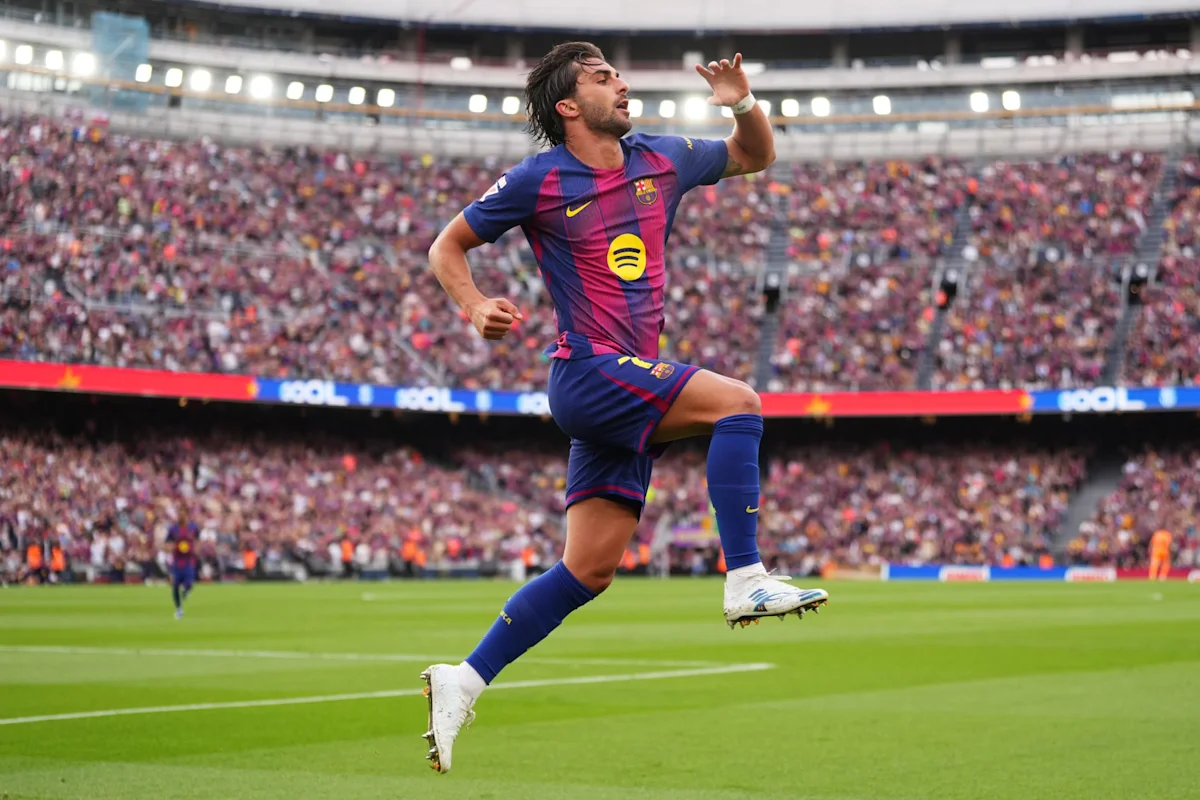
Headline: Ferran Torres Transitions from Barcelona to PSG After Successful Stint
In December 2021, Barcelona made a notable move by signing Ferran Torres from Manchester City, despite the club facing severe financial challenges. At that time, President Joan Laporta had disclosed that the club’s debt had reached €1.35 billion. The departure of Lionel Messi had already illustrated the fiscal difficulties, as the club could not arrange a new contract for the star player, coupled with La Liga imposing a spending cap on the club for the season.
Despite these obstacles, the Catalan side managed to allocate €55 million for Torres, with an additional €10 million possible based on performance incentives, marking a significant step in trust towards a promising young forward.
Fast forward four and a half years, Ferran Torres exits Barcelona, joining Paris Saint-Germain for a reported fee of €50 million, with a contract lasting until 2031. This transfer follows Torres’ impressive goalscoring season with Barcelona, where he scored the winning goal in extra time in the World Cup final, securing victory for Spain.
A Promising Start
The initial acquisition of Torres appeared straightforward. At just 21, he was young, versatile, Spanish, and had already adapted to the demands of positional football under Pep Guardiola. He showcased his ability to play across various positions, often displaying instincts that set him apart from typical wingers.
In his initial six months at Barcelona, Torres scored seven goals in 26 matches. While there were signs of inconsistency, his movement and offensive drive were evident, as he demonstrated an ability to anticipate space before it emerged.
However, in the following years, despite possessing the qualities that could define his football career, Barcelona struggled to fully harness his potential, often reducing his versatility to an ambiguous label.
Struggles Amidst Competition
The 2022-23 season revealed more challenges for Torres. With the arrival of Robert Lewandowski and Raphinha, along with Ousmane Dembélé reaching top form, Ferran found himself less central to the team’s attacking strategy. He scored seven goals across 45 games, the same tally he achieved in a significantly shorter first half-season.
As a winger, he faced competition from players more adept at exploiting wide positions, leading to questions regarding his role. Such ambiguity became a defining aspect of his tenure as he earned the reputation of being a “useful player,” yet not living up to his hefty price tag.
Despite some resurgence in the 2023-24 season—with a standout performance including a hat-trick against Real Betis—he still faced an identity crisis within the squad.
A New Role Under Flick
Hansi Flick’s arrival marked a turning point for Torres. The new coach clarified his role, primarily designating Torres to play as a striker rather than isolating him on the touchline. This adjustment not only utilized his strengths effectively but also allowed his movement to flourish.
The transformation was immediate, with Torres achieving a career-high 19 goals and seven assists in 2024-25, also becoming the top scorer in the Copa del Rey. His ability to contribute significantly asserted him as a valuable asset to the squad.
Evolving Into a Key Player
The following season saw Ferran solidify his standing as more than just an alternative option. He netted 21 goals and provided three assists in all competitions, showcasing a different style of play that emphasized running and pressure. By April, he reached 200 appearances for Barcelona, and discussions about his role shifted; he became a tactical choice rather than a mere rotation option.
Still, Ferran had his share of inconsistencies, embodying the unpredictable nature of his career at Barcelona. Yet, they focused on establishing his identity as a player rather than pursuing a flawless rendition.
A Timing Conundrum
The decision to sell Ferran at this point has been met with confusion. Typically, high-profile signings leave when clubs recognize a miscalculation, but Barcelona is parting with Torres at a peak moment in his career. This presents a contradiction characteristic of modern-day Barcelona; financially motivated yet sporting wisdom would suggest retention.
The potential for him to flourish was evident, echoed by memories of Ousmane Dembélé’s own rejuvenated career in Paris. There’s an implicit belief that Torres has yet another level to reach, albeit not within Barcelona’s confines.
Assessing the Outcome
Ultimately, assessing Torres’ success at Barcelona boils down to perspective. Labeling him a full success seems generous given the hefty investment and moments when he appeared sidelined in the attack. Conversely, dismissing him as a failure is equally challenging; he departs with seven major trophies including three La Liga titles and a Copa del Rey, alongside impressive personal statistics of 207 matches and 65 goals.
Throughout his time at Barcelona, Ferran navigated trials and tribulations, never the central figure yet always a component of the narrative. While Spain will remember his moment in the World Cup final, Barcelona’s recollection may reflect a more nuanced view. His journey demonstrates that, while he may not become a club legend, he remains an unmistakable chapter in Barcelona’s ongoing story.
There was something irrational about Barcelona signing Ferran Torres from Manchester City in December 2021.
The club were drowning in debt. President Joan Laporta had revealed only months earlier that Barça owed €1.35 billion.
Advertisement
Lionel Messi had departed because the club could not make the numbers on a new contract work, and La Liga had imposed a spending limit on the Blaugrana that season.
Barcelona could buy Ferran, but even registering him for the La Liga campaign required further financial manoeuvring.
Yet the Catalans found €55 million, with another €10 million potentially payable in variables, and spent it on a 21-year-old forward from Manchester City.
It was more than a transfer. It was one of the first significant acts of faith of the new era, and it came on an unproven Spaniard with potential.
Dani Alves had technically become Xavi Hernandez’s first signing a few weeks earlier, but Ferran was the first major investment in the new coach’s project.
Advertisement
Four and a half years later, Ferran leaves for PSG for a reported €50 million, signing until 2031.
He does so having just completed the best goalscoring season of his Barcelona career and, weeks earlier, scored the extra-time winner that made Spain world champions.
It is an extraordinary place for the story to end because Barça spent much of these four and a half years trying to figure out what they had bought.
It looked straightforward
A €55 million signing from Man City. (Photo by David Ramos/Getty Images)
At the beginning, the answer seemed quite obvious. Ferran was young, versatile, Spanish and already accustomed to positional football under Pep Guardiola.
Advertisement
He could operate from either flank, attack space without the ball and appear inside the penalty area with the instincts of someone more comfortable around goal than the average winger.
His first six months offered enough encouragement. He scored seven times in 26 appearances after arriving midway through the 2021-22 season.
There were imperfect finishes and frustrating nights, but there was plenty of movement and attacking impetus to like.
Ferran understood where space was going to appear before it actually did.
He attacked the back post. He ran beyond defenders. He drifted from wide positions towards the penalty area rather than waiting for the game to arrive at his feet.
Advertisement
Looking back now, Barcelona were already seeing the qualities that would go on to define him as a footballer.
They simply misinterpreted them for a significant while. For years, Ferran was spoken about through his versatility.
He could play on the left. He could play on the right. He could fill in through the middle. It started off as a compliment but eventually became his problem.
Versatility slowly gave way to uncertainty
The 2022-23 season was when the cracks began to appear. Barça had signed the likes of Robert Lewandowski and Raphinha and had Ousmane Dembele in the best form of his career at the club.
Advertisement
They were no longer as dependent on Ferran as they had been in his first half-season. The forward scored seven goals in 45 games, exactly the same number he had managed in 26 matches during his first half-season.

The 2022/23 season was a frustrating one for Ferran personally. (Photo by Alex Caparros/Getty Images)
There were players better suited to receiving wide and beating opponents. There was one of the greatest centre-forwards of his generation occupying the penalty area.
So, where exactly was Ferran meant to adapt? This was a question that would follow him throughout the Xavi era.
He was a winger who often looked most dangerous when leaving the wing. A forward capable of playing centrally without being treated as the team’s centre-forward.
Advertisement
He slowly got labelled a “useful player”, but not in the right connotation. At least, the €55 million price tag did not allow him to be viewed as that.
The fee became part of every poor performance. Every missed chance carried extra weight. Every indifferent display reopened the same conversation.
To his credit, Ferran improved in the 2023-24 season. There were flashes of something more substantial, including a hat-trick against Real Betis, but the identity crisis remained.
Barcelona knew the 26-year-old could do several things. It took Hansi Flick to decide what he did not need to do.
Flick’s greatest invention with Ferran was to keep things simple
Flick did not invent Ferran Torres, the striker. Pep Guardiola had used him centrally at Manchester City, while Barcelona had occasionally done the same before the German arrived.
Advertisement
What changed was the role clarity and definition that Flick gave Ferran. In many ways, he simplified him.
He was used less and less on the touchline. His position was not left ambiguous like in previous years. He was given a very clear mandate: you will play as a striker.
Under Flick, the attributes that sometimes seemed awkward on the wing suddenly became coherent.

Flick unlocks Ferran. (Photo by David Ramos/Getty Images)
The constant movement mattered more than isolation dribbling. His willingness to sprint behind centre-backs became an attacking weapon.
His instinct to arrive in scoring positions was no longer something dragging him away from his role and became the very thing Flick fed into.
Advertisement
The transformation showed immediately in the numbers. Ferran reached 19 goals and seven assists in 2024-25, his best season at the club to that point.
He also finished as the Copa del Rey’s top scorer with six goals, scoring the late equaliser against Real Madrid in the final before Barça won in extra time.
This was not the prettiest version of Ferran. However, it was easily the most coherent one.
From Lewandowski’s alternative to a Barcelona No. 9
The second season under Flick confirmed that his striker evolution was more than just a prolonged purple patch.
Ferran scored 21 goals and supplied three assists in 49 appearances across all competitions in 2025-26.
Advertisement
In La Liga, his 16 goals earned him the Zarra Trophy alongside Lamine Yamal as the division’s highest-scoring Spanish player.
By April, he had reached the milestone of 200 Barça appearances. More importantly, the discussion around him had changed.
Previously, Ferran starting games ahead of Lewandowski meant rotation. Now, it had emerged as a legitimate tactical choice.
Lewandowski remained Lewandowski: pedigree, penalty-box presence and an almost absurd body of goals behind him.

Ferran produced his career-best numbers last season. (Photo by Denis Doyle/Getty Images)
Ferran offered something different. More running. More pressure. More movement across and behind a defensive line.
Advertisement
There were games where Flick realised that he needed that kind of striker more than he did someone like the veteran Pole, whose legs kept getting wearier with every passing day.
There were still droughts because the Spaniard’s Barcelona career was never going to become completely linear.
There were still moments when the finishing deserted him and the old frustrations resurfaced. However, that is part of who Ferran is.
Barça’s success was not transforming the 26-year-old into something flawless. It was about transforming him into something identifiable.
Just as everything made sense, Paris swooped in
That is what makes the timing of this farewell very strange.
Advertisement
Most expensive signings leave when the club accepts that they miscalculated with the player and sell him on to cut their losses.
Barça are doing the exact opposite with Ferran. They are parting ways with him at a time when his stock is at the highest it has ever been in his career.
There is something very modern-Barça about the contradiction. For perhaps the first time since Ferran arrived, the sporting case for keeping him is crystal clear.
That is also the reason why the financial case for selling him has become so compelling. That, along with the fact that he wanted PSG.
Barcelona bought potential and transformed it into a near-finished product, only for PSG to swoop in. It has a sense of deja vu.
Advertisement
It is not too dissimilar to what happened with Ousmane Dembele a few seasons ago and how his career has transformed since moving to Paris.
This is not to suggest that Ferran will go on to become a Ballon d’Or winner in France, but there is a feeling that he still has one more level to his game that Barça will not get to enjoy.

Ferran says goodbye. (Photo by Sarah Stier/Getty Images)
So, was Ferran Torres a successful Barcelona signing?
Eventually, it all comes down to this one question.
Calling him an unequivocal success feels generous considering the size of the original investment and the long stretches when he seemed peripheral to Barcelona’s best attack.
Advertisement
Terming him a failure is even harder to defend. He leaves with seven major trophies: three La Liga titles, three Spanish Super Cups and a Copa del Rey.
On a personal note, he leaves with 207 appearances and 65 goals. Those are not the numbers of a failed story.
For much of his Barcelona career, Ferran survived. He survived tough spells under Xavi. He survived uncomfortable games on the wing.
He was rarely central to the story. However, he was always part of it.
Spain may remember Ferran Torres through one clean image: the ball reaching him in extra time of a World Cup final, the finish and the eruption that followed.
Advertisement
Barcelona’s memory of him may always remain a bit more clouded than that.
Back in 2022, Ferran said: “Haaland and Mbappe? I think that I can compete with them, I know how far I can go.”
The 26-year-old can still go on to live up to that prophecy. It just will not be in a Barcelona jersey.
He will not leave as one of Barcelona’s great forwards. He will leave as something more complicated: not a legend, not a failure, but an unmistakable Blaugrana story.
[/gpt3]