
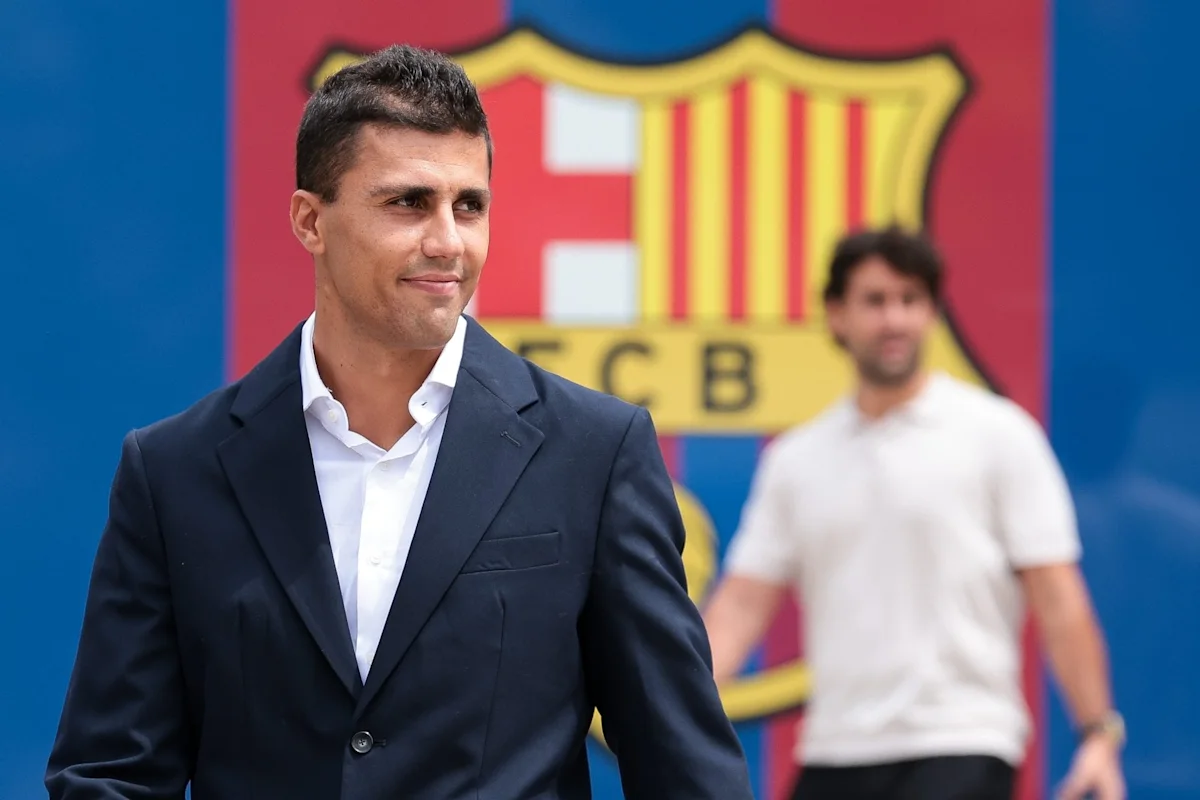
Headline: Barcelona Secures Rodri from Manchester City with Ambitious Goals Ahead
Barcelona has officially secured the signing of Rodri from Manchester City, bringing the reigning world champions’ captain and 2024 Ballon d’Or winner to Camp Nou. The 30-year-old midfielder joins on a contract that extends until June 2030, following his remarkable achievement of being named the best player at the 2026 FIFA World Cup. His arrival marks a significant comeback after he dealt with a serious knee injury that interrupted a peak phase in his career.
While some may label Rodri as the long-awaited replacement for Sergio Busquets, this characterization may not fully encapsulate his capabilities. Rodri plays a larger role than just filling one position; he transforms the dynamics of Hansi Flick’s team.
The Player Between Actions
Rodri’s approach to the game is methodical. Barça will likely notice that he does not rush his decisions. He receives the ball, scans his options, and then releases it—sometimes forward, sideways, or backward. His passes may appear deceptively simple, yet they often lead to a restructured opposition that eventually creates space for others.
At Manchester City, Rodri emerged as a crucial player thanks to his understanding that possession extends beyond just keeping the ball; it involves manipulating the opponent’s defensive shape. According to the metrics from the 2025-26 season, Rodri ranked impressively in several categories: 90th percentile for progressive passes, 98th for territory gained, and 92nd for progressive pass accuracy, indicating his nuanced understanding of advancing the play.
He does not engage with possession only to search for a key pass; Rodri expertly guides the dynamics until a decisive move becomes apparent, much like a chess master strategizing several steps ahead.
The Control of Game Tempo
Rodri’s exceptional ability to manage the pace of the game stands out. He was in the 97th percentile for actions that accelerate possession, and the 98th percentile for actions that reset the tempo of play. This reveals that he is not merely a steady influence; he acts as a conductor of the team’s rhythm. He discerns when to speed up play and when to slow it down, which highlights his strategic mindset.
Interestingly, Barcelona already has a midfielder in Frenkie de Jong who excels in this area as well, albeit through different methods. While both players are adept at controlling tempo, their styles differ, with Rodri focusing on positioning and passing, and De Jong leveraging movement and ball-carrying.
Rodri’s performance in the World Cup showcased this again as he anchored Spain’s midfield, demonstrating his capacity to manage the game’s flow even in high-pressure situations.
A Ripple Effect on the Team
For Hansi Flick, Rodri’s inclusion raises excitement not just about his contributions but also about how he will enhance the performance of those around him. Barcelona previously demonstrated dominance in La Liga, besting Real Madrid by 14 points, yet aspirations in Europe have not met the same success.
Rodri enhances this perspective because his defensive contributions hinge more on anticipation than reactive measures. His stats reveal he ranked in the 96th percentile for recoveries while retaining possession 91.3% of the time, indicating his value lies not just in regaining the ball but also in transforming those recoveries into sustained possession.
If the full-backs venture forward, Rodri stays back as a safety net. His presence allows teammates to advance without constant oversight of their defensive duties.
A Partnership with Pedri
The most significant beneficiary of Rodri’s arrival might be Pedri. Historically, Barcelona asks Pedri, their most creative midfielder, to provide control amidst his playmaking. Rodri’s presence allows Pedri to focus more on creativity rather than ball retention, facilitating better positioning to receive the ball after opponents have moved.
Rodri enhances the space Pedri needs, allowing the latter to operate without the constant burden of initiating possession. This subtle partnership will allow Pedri to focus on creating opportunities closer to the goal.
Considerations for the Future
However, caution is warranted. Rodri arrives at the age of 30, coming off a series of injuries. His recovery has been lengthy, including an ACL injury that sidelined him for over seven months. Although he has expressed readiness to contribute once deemed fit by Flick, Barcelona will need to manage his playing time wisely to maintain his effectiveness.
While Rodri’s defensive statistics are exemplary, his performance declines when he is pulled away from central positions. The challenge for Barcelona will be to keep him concentrated in roles where he can optimize his skills.
Potential Champions League Impact
Ultimately, Barcelona’s ambitions in Europe remain at the forefront. The team experienced heartbreak in last year’s Champions League quarter-finals, falling to Atletico Madrid after narrowly missing opportunities.
Rodri, who scored the goal that clinched Manchester City’s first Champions League title, brings significant experience in high-pressure matches. However, while his presence offers stability and potential success, he alone cannot guarantee a Champions League triumph.
Rodri’s signing symbolizes a hope for improvement, marking a new chapter at Camp Nou as Barcelona seeks to elevate its European standing. With his arrival, the stage is set for exciting developments at the club as they aim to reclaim their dominance on the continental front.
Drop a pebble into a pond and the pebble never touches the bank. The water does.
Football has always tended to gravitate towards the person who finishes the action. The winger who beats his man. The playmaker who threads a pass. The striker who finishes the chance.
Advertisement
We spend considerably less time thinking about the player who creates the conditions that make these actions possible.
That is where Rodri lives. He has always been fascinating for precisely this reason.
Barcelona have officially signed the 30-year-old from Manchester City on a contract until June 2030, bringing the reigning world champions’ captain and 2024 Ballon d’Or winner to the Camp Nou.
He arrives having just been named the best player at the 2026 FIFA World Cup, completing an extraordinary return from the serious knee injury that interrupted the peak of his career.
The temptation is to call him Barcelona’s long-awaited Sergio Busquets replacement. There is truth in that statement, but it also undersells Rodri.
Advertisement
Rodri is simply not the answer to one position. He changes the geometry of Hansi Flick’s team.
The player between the actions
There is nothing hurried about Rodri. That may be the first thing Barça notice.
He receives, scans and releases. Sometimes forward, sometimes sideways, occasionally backwards. The pass itself can look almost insultingly simple.
Then, three passes later, the opposition are stretched and somebody else is running into space.
At Manchester City, Rodri became one of football’s great controllers because he understood that possession is not merely about retaining the ball. It is about manipulating what the opponent has to defend next.
Advertisement
The 2025-26 season data captures the contradiction beautifully. Rodri ranked in the 90th percentile for progressive passes, the 98th percentile for territory gained, and his progressive pass accuracy sat in the 92nd percentile.
Yet progressive passes represented a relatively modest share of his total distribution because Rodri does not confuse forward with progress.
He does not spend possession desperately searching for the decisive ball. He moves opponents until the decisive ball becomes sensible.
It is almost like a chess master moving his pieces around the board. It is calculated in his head before others can see it on the pitch.
Advertisement
That distinction has defined his career. His years under Pep Guardiola turned him into the reference point of a Manchester City side that won four consecutive Premier League titles and the Champions League.
He thrived at being the player between the actions. He created the conditions for those actions to exist.
Rodri does not slow down the game; he decides when it needs to be fast
Perhaps the most revealing numbers concern tempo.
Rodri ranked in the 97th percentile for actions that accelerated possession and in the 98th percentile for actions that reset and settled it again.
That combination is the point. Rodri is not simply a metronome profile. He is closer to a conductor.
Advertisement
He understands when the team needs another pass and when another pass would merely give the opposition time to recover.
His relatively long release times are not indecisiveness. The extra second is not hesitation. Instead, it is football’s version of reconnaissance.

Interestingly, Barça already have another midfielder in the squad who excels at just this: Frenkie de Jong.
The Dutchman is often misunderstood as slowing down the tempo of a game. The truth is that he decides exactly when a game needs to be accelerated.
He understands that there is no sense in making a forward pass if the risk of a turnover is higher. He waits and manipulates the pitch until the right moment arrives to release the pass.
Advertisement
However, there is a difference. While Rodri does this through his metronome-like positioning and passing, De Jong does it through his movement and ball-carrying. It is all the same science, but the method to get there is markedly different.
At the World Cup, that control returned in its clearest form. Against France in the semi-final, Rodri anchored Spain’s midfield, protected the centre alongside Pau Cubarsi and Aymeric Laporte and repeatedly shut down potential danger.
It does not always look like Rodri is dominating the match. Zoom out a little, though, and you realise the game is being played at the speed he decided.
The ripple effect
For Hansi Flick, this may be the most exciting part of Rodri’s signing.
Advertisement
Not simply: what does Rodri do? It is more: what can everybody else do because Rodri is there?
Barcelona have already proved that Flick’s high-wire football can dominate Spain. They won a second consecutive La Liga title last season, finishing the decisive El Clasico 14 points clear of Real Madrid at the top.
Europe has been less forgiving.
Rodri changes that equation because his defensive value is not based on fire-fighting. It is based on anticipation.
Rodri ranked in the 96th percentile for recoveries and retained possession after 91.3 percent of them. Those two need to be looked at together as a combination.
Advertisement
That second action may be as valuable as the first. Barcelona can sometimes turn one transition into another: win the ball and force the next pass. However, there is no sense in that if they lose the ball immediately after.
Rodri changes this. He does not merely recover possession. He converts the recovery into possession.

If the full-backs advance, he becomes insurance behind them. If Cubarsi steps forward, Rodri protects the space he leaves. If Pedri ventures further forward, he does not have to keep looking over his shoulder.
The pebble lands in midfield. The wave reaches everyone.
Pedri x Rodri
Nobody may benefit more than Pedri.
Advertisement
For years, Barcelona’s relationship with Pedri has contained a strange contradiction: their most imaginative midfielder has also frequently been asked to provide the control.
Pedri can do it. That does not mean Barcelona should want him to do it all the time.
Rodri offers the possibility of redistributing that responsibility. Less responsibility for beginning every possession. More opportunities to receive after the first defensive line has already moved.
Fewer touches beside the centre-backs simply to ensure Barcelona escape pressure. More touches between midfield and defence, closer to Lamine Yamal, Dani Olmo and the penalty area.
Advertisement
The partnership should not be understood as Rodri giving the ball to Pedri and waiting for magic. It is far subtler.
Rodri’s gift to Pedri is improving the conditions in which the latter receives the ball.
The recipient maps from his final Man City season tell a story. Rodri repeatedly supplied midfielders such as Bernardo Silva and Rayan Cherki. His job often ended where theirs began.

That is the relationship Barcelona should want.
Despite there being some concerns regarding their partnership at international level, Flick has very little reason to worry that the duo are unlikely to thrive in his system.
Advertisement
Spain and Barça may have many overlapping players, but their systems are not remotely similar, and Pedri is likely to be the biggest beneficiary of having Rodri at Barça.
Rodri provides the floor that allows Pedri the chance to raise the ceiling.
Not a magic eraser
There should still be caution. Rodri is 30 and arrives after two difficult years from a fitness perspective.
His ACL injury kept him out for more than seven months, while knee and hamstring issues followed and he underwent minor back surgery after the World Cup.
He has insisted he is ready to train and play once Flick considers him prepared, but Barcelona will have to manage his minutes carefully.
Advertisement
There is also a tactical warning. While his defensive numbers are unmatched centrally, they drop rather remarkably when he is dragged towards the flanks.
However, Barça’s success would lie in ensuring Rodri is not dragged into such positions on a consistent basis.
Rodri can turn Flick’s Barcelona from a junk bond into a government bond. However, he does not remove the risk.
Does Rodri bring the Champions League back to Camp Nou?
Eventually, all roads lead to Rome.
Barcelona’s domestic revival under Flick is already real. What remains is Europe.
Last season, Atletico Madrid eliminated them 3-2 on aggregate in the Champions League quarter-finals.
Advertisement
Barcelona overturned the first-leg deficit temporarily in Madrid and dominated long periods of the return, but once again the tie came down to the margins: transitions, a red card and a lack of control.
Rodri knows this competition. He scored the goal that won Manchester City’s first Champions League.
He has controlled title races, survived the pressure of knockout football and has now returned from a career-altering injury to captain his country to a World Cup.
Does that mean Barcelona will win the Champions League? Of course not.
Rodri cannot guarantee Pedri’s fitness, finish Lamine’s chances, defend every counterattack or minimise the uncertainty associated with European knockout football.
Advertisement
One midfielder cannot carry the Champions League back to the Camp Nou. However, he certainly can get them closer.
Drop the pebble. Then watch what happens around it.
*Data source: Tools developed by X/pranav_m28 – PlayerPrint
[/gpt3]