
Argentina’s World Cup Campaign Ends with Disappointing Final Performance
Don’t cry for them, Argentina. Some tears were shed by Lionel Messi after an unsatisfactory end to one of the great World Cup careers. However, his team-mates merit rather less sympathy. What had been a valiant and dramatic attempt to retain the World Cup ended with a display lacking discipline, creativity, and, above all, shots.
The historic feat for Argentina was not becoming the first team since Brazil in 1962 to win consecutive World Cups, but rather being officially the least attacking team in a final. Argentina failed to register a single shot in 90 minutes, finishing with an xG of 0.00 when the match went to extra time. Spain had 20 shots before Argentina even attempted their first, which came in the 121st minute.
Advertisement
This underwhelming performance came from a team featuring Messi, who has scored more World Cup goals than anyone else and is widely regarded as one of the greatest footballers ever. A team with Messi should not present itself in such a dull manner, heavily focused on delaying and disrupting play.
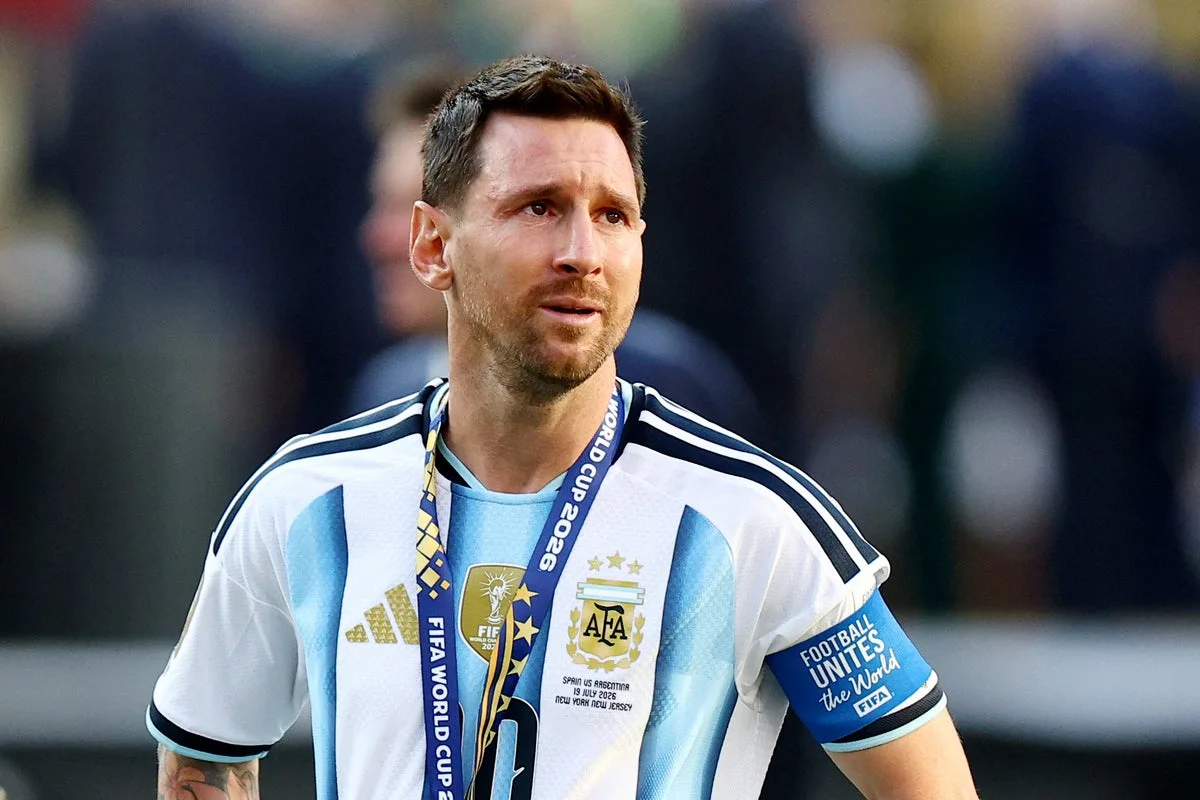
Argentina offered nothing in the final and Messi was left anonymous (Reuters)
Yet, after Fifa delayed entry into MetLife Stadium, Argentina wasted their time on the pitch. If anything could be relished from this experience of futility, it may be the thought that they bored Donald Trump and the array of celebrities who managed to acquire tickets that could have gone to actual supporters.
The many actors among them may have been perplexed by what was envisioned as a blockbuster that often lacked drama, with the eventual standout performance coming from Ferran Torres, who did not even feature prominently until later in the match. Meanwhile, Messi endured an uncharacteristic descent into anonymity.
His final tally stands at three World Cup finals: one victory and two 1-0 losses. For six weeks, the improbable had seemed possible: that, at 39, he could replicate the 2022 final, where he scored two goals and lifted the trophy. This World Cup had felt like a continuation of the last for Messi, scoring in the first five games, surpassing Miroslav Klose’s all-time scoring record, and closing in on the Golden Boot. In a country where many spend fortunes trying to defy aging—perhaps some of Fifa’s notable guests included—Messi appeared to have found a method requiring nothing more than his footballing prowess.
Advertisement
However, this was the first match in which he truly failed to make an impact. He had scored in the first five games and contributed against Switzerland and England. Julian Alvarez, a forward with a potential £150m fee, found himself on the left of midfield before being substituted.
Messi will be 43 by the time the next World Cup comes around and he was given no support against Spain (Getty)
The lack of ambition displayed by Argentina was staggering. Perhaps their history of late goals led them to believe that an early score was unnecessary. Yet it was only after Torres’ eventual strike that they came alive. Some credit must go to Spain’s robust defense, but only partially. It underscored that, until now, a team lacking pace and width had thrived primarily due to their reliance on Messi.
As he was denied service, Argentina resorted to anti-futbol tactics. They showcased their best footballing attributes throughout this tournament, but in the crucial match, they reverted to their worst instincts.
In terms of finals involving Argentina, this performance resembled more the 1990 encounter than the 2022, 1986, or 1978 matches. Enzo Fernandez‘s deserved dismissal may have highlighted his foolishness in receiving a yellow card for dissent. When he fouled Pau Cubarsi, he could have been fortunate to have only received a second yellow card. The third Argentinian to be sent off in a World Cup final hesitated to leave the pitch, possibly believing he had evaded sufficient disciplinary measures based on previous matches.
Advertisement
Fifa may soon need to take action against another Argentinian, Leandro Paredes was called upon at half-time and quickly received a booking for an off-the-ball collision with Rodri. Following the final whistle, he tossed Gavi to the ground, perhaps in a fit of anger.
Leandro Paredes was involved in ugly clashes with Eric Garcia and Gavi at full time (Reuters)
Ezno Fernandez sent Pau Cubarsi flying after getting a stupid yellow card for dissent (Getty)
After Fernandez’s dismissal, Argentina faced an uphill battle. In their attempt to defend the title, their focus shifted entirely to defense. Emi Martinez grew increasingly busy, delivering impressive saves against Lamine Yamal’s free-kick and a header from Nico Williams.
Over the course of 120 minutes, this side appeared increasingly far removed from the squad that had previously won a World Cup and two Copa Americas. They were outclassed and outpassed by Spain, arguably the first top-tier team they encountered during this tournament. When the draw was announced, they could have faced Portugal in the quarter-finals and Brazil in the semi-finals, but encountered neither. Despite that, they still faced struggles throughout their journey, crafting dramatic finishes in four knockout rounds.
Ultimately, Argentina tarnished the memory of their past victories and glory days. Their performance was unremarkable and unthreatening. A familiar tune by Frank Sinatra echoed before kick-off, and it seems Argentina played the match their own way.