
Ferran Torres Scores to Secure Spain’s Second World Cup Title
Pedro Porro sent a cross soaring into the air, as Argentina’s defenders shielded their eyes, trying to track the ball. Quietly, Nico Williams headed it back into the box, where Ferran Torres found himself momentarily unmarked by a struggling Giuliano Simeone. He steadied himself and struck the ball with his left foot, finding the net just above Emiliano Martinez’s gloves, sending him into a frenzy of celebration.
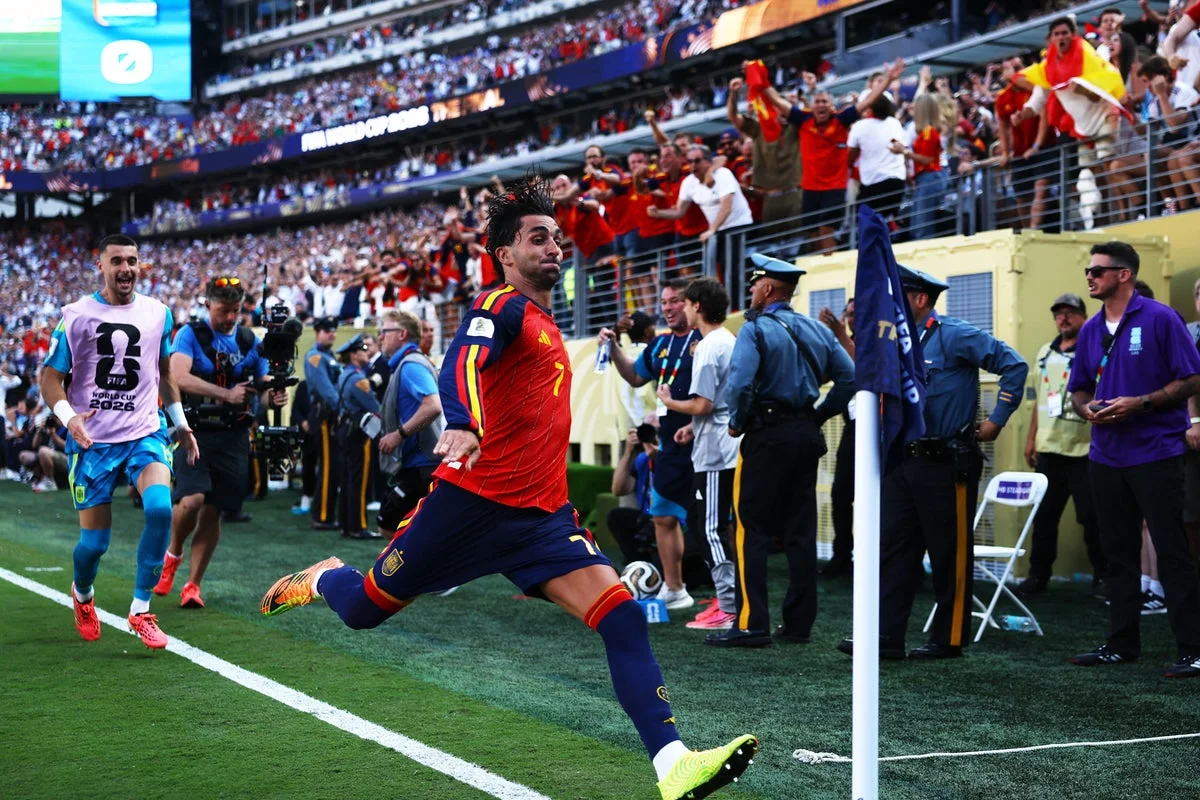
What do you do after you’ve just won your country the World Cup? Marco Tardelli shed tears of joy, and Andres Iniesta took off his shirt. Torres chose to take out his excitement on a corner flag.
Ferran Torres celebrates after scoring Spain’s World Cup final goal (Reuters)
The pitch erupted in chaos while fans in the stands celebrated wildly. Cameras shifted from Torres’s jubilant moment to capture a group of smiling men in suits, including Sergio Ramos hugging David Villa and Iker Casillas playfully running his fingers through Carles Puyol’s hair, while Iniesta offered a slight clap and smile.
Advertisement
Only Iniesta fully understood that feeling. Sixteen years earlier, he had received a similar pass and scored to give Spain their first World Cup title, defeating the Netherlands 1-0 in Johannesburg. Now, they mirrored that achievement by winning against Argentina in New Jersey. Iniesta and Torres will forever be linked by that euphoric moment.
“I think in the end the goal came from 47 million people, not just those of us that are here,” Torres stated emotionally. “Today, destiny was written. We tried to stay as close as possible to our people.”
Spain claimed their second World Cup in a manner similar to their first, dominating possession and wearing down opponents. Portugal struggled to find their footing, Belgium were edged out, and France were left stunned. Argentina approached the match with a surprisingly aggressive style, which forced Spain to maintain their composure and patience.
Advertisement
Few will remember the lackluster nature of the final. The match will be recalled through vivid snapshots: Pau Cubarsi being upended by Enzo Fernandez, Simeone pushing a late shot into the stands, Lionel Messi deep in thought on the pitch, Rodri in tears, and Leandro Paredes seemingly losing control of himself. The physicality during the match evoked memories of 2010, when Nigel De Jong escaped punishment after a reckless challenge on Xabi Alonso.
Ferran Torres, left, turns away to celebrate after scoring Spain’s winner (Getty)
Spain’s Ferran Torres lifts the trophy with teammates (Reuters)
In future comparisons, the two esteemed generations of Spanish football will certainly see varied evaluations, with many of the legendary figures watching from above. Those who shaped modern football cast a long shadow over the current squad, whose identity is less distinct. However, they followed the rich tradition established by Spain, playing with a style that transcends individual accolades and coaches.
Torres’s goal strikingly echoed Iniesta’s earlier triumph. Iniesta had faced adversity early in the tournament before shining brightly during Spain’s victory in South Africa. Torres also had to wait patiently for his moment and dealt with criticism for earlier showings, ultimately channeling his frustrations into that corner flag incident.
Torres celebrates as Spain’s substitutes run to join him (PA)
At just 26, Torres still has time to carve out a lasting legacy at Barcelona, potentially emulating Mario Gotze, who netted Germany’s winning goal in 2014 but did not reach the stardom many anticipated. Nevertheless, his World Cup-winning moment will forever define his career, securing his place alongside Iniesta as a pivotal figure in Spain’s football history.