Headline: Countdown Begins for 2027 FIFA Women’s World Cup Draw in Brazil
The countdown is on for the 2027 FIFA Women’s World Cup, with just one month remaining until the highly anticipated final draw takes place in Brazil.
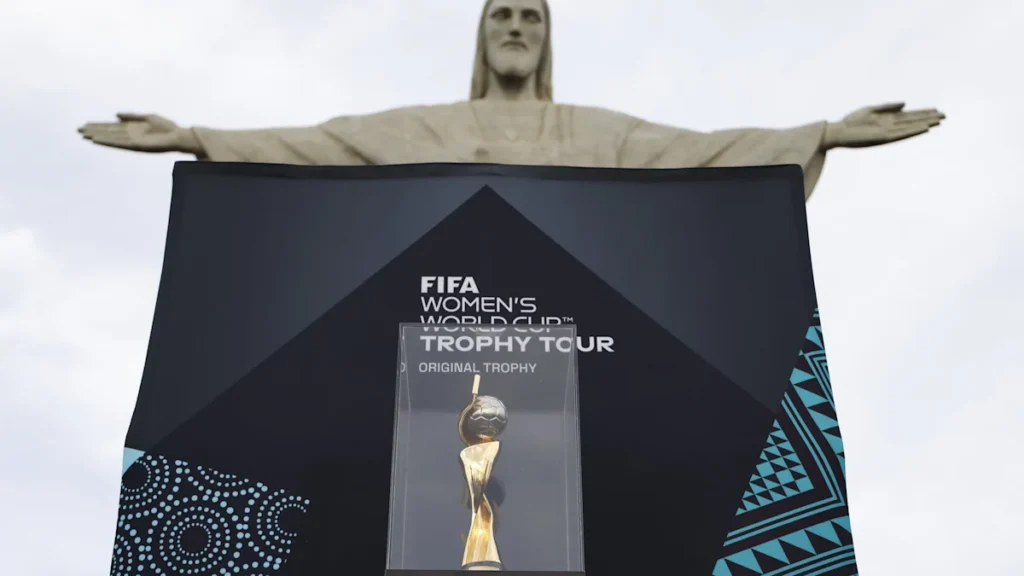
The final draw is scheduled for Friday, 11 December 2026, at the Museum of Modern Art in Rio de Janeiro at 13:30 local time. This event will set the stage for the group phase matchups, determining the path for the 32 nations competing for the prestigious title in women’s football.
Advertisement
Representatives from the qualified nations will converge in Brazil, accompanied by football legends and special guests, to participate in an event that will officially outline the journey to the 2027 tournament.
The draw for the final phase of the World Cup play-off tournament will occur a day earlier, on 10 December, at 11:00. This draw will establish the fixtures needed to finalize the last three spots in the tournament.
Understanding the 2027 FIFA Women’s World Cup Draw
The draw will consist of four pots, each containing eight teams. As the tournament hosts, Brazil will automatically occupy Pot 1 and be placed in Group A, position A1. The distribution of the remaining 31 teams across the four pots will align with the FIFA Women’s World Ranking, published on Monday, 7 December 2026.
Advertisement
The seven highest-ranked teams will join Brazil in Pot 1, with the next eight teams assigned to Pot 2. The subsequent eight will fill Pot 3, while the final five qualified teams and three placeholders for play-offs will complete Pot 4.
The draw process will commence with Brazil before drawing the other teams in sequence from each pot, beginning with Pot 1 and concluding with Pot 4.
Key Restrictions in the Draw Process
FIFA has implemented certain restrictions to ensure competitive balance and geographic diversity during the group stage. Generally, no group will include more than one team from the same confederation. An exception exists for UEFA, which will have a minimum of 11 representatives—potentially rising to 12 based on playoff outcomes. Therefore, each group will feature at least one UEFA team, with a maximum of two allowed.
Advertisement
Additional guidelines will separate the four highest-ranked teams in the FIFA Women’s World Ranking. The two top teams will be positioned on opposite sides of the tournament bracket, while the third- and fourth-ranked teams will also be kept apart. As a result, if the highest-ranked teams progress, they cannot meet until the final match.
Final Spots Yet to Be Decided
Although 29 teams will secure their places in the tournament through qualification, three spots will remain open at the time of the final draw.
The FIFA Women’s World Cup 2027 Play-Off tournament will determine these last three participants, with its preliminary phase set to take place in Rabat, Morocco, from 28 November to 5 December 2026.
Advertisement
Chinese Taipei, Uzbekistan, South Africa, Papua New Guinea, Ghana, and Ecuador will compete for advancement. Two teams will progress from this initial phase to join four nations that have qualified directly for the final match. This includes two teams from Concacaf, Venezuela from CONMEBOL, and one from UEFA.
The concluding phase will unfold during the women’s international match window spanning from 23 February to 6 March 2027, featuring single-match encounters where each winner will earn a place in the World Cup.
A Milestone Event for Women’s Football
The World Cup will occur from 24 June to 25 July 2027 across eight vibrant host cities. This competition marks the tenth edition of the Women’s World Cup and serves as a historic milestone as Brazil becomes the first South American country to host the tournament.
Advertisement
With the draw approaching, anticipation grows as nations get ready to learn about their opponents and chart their paths toward the ultimate accolade in international football.
For Brazil, the tournament presents a chance to display its deep connection to football on a global stage. For the competing nations, it heralds the start of a journey fueled by ambition and dreams.
Related articles from Her Football Hub:
-
Iceland international Dagný Brynjarsdóttir announces retirement after 29-year football career
-
FA and WSL launch major research project into ACL injuries in women’s football
-
Women’s football finances: Who protects teams when funding stops?