
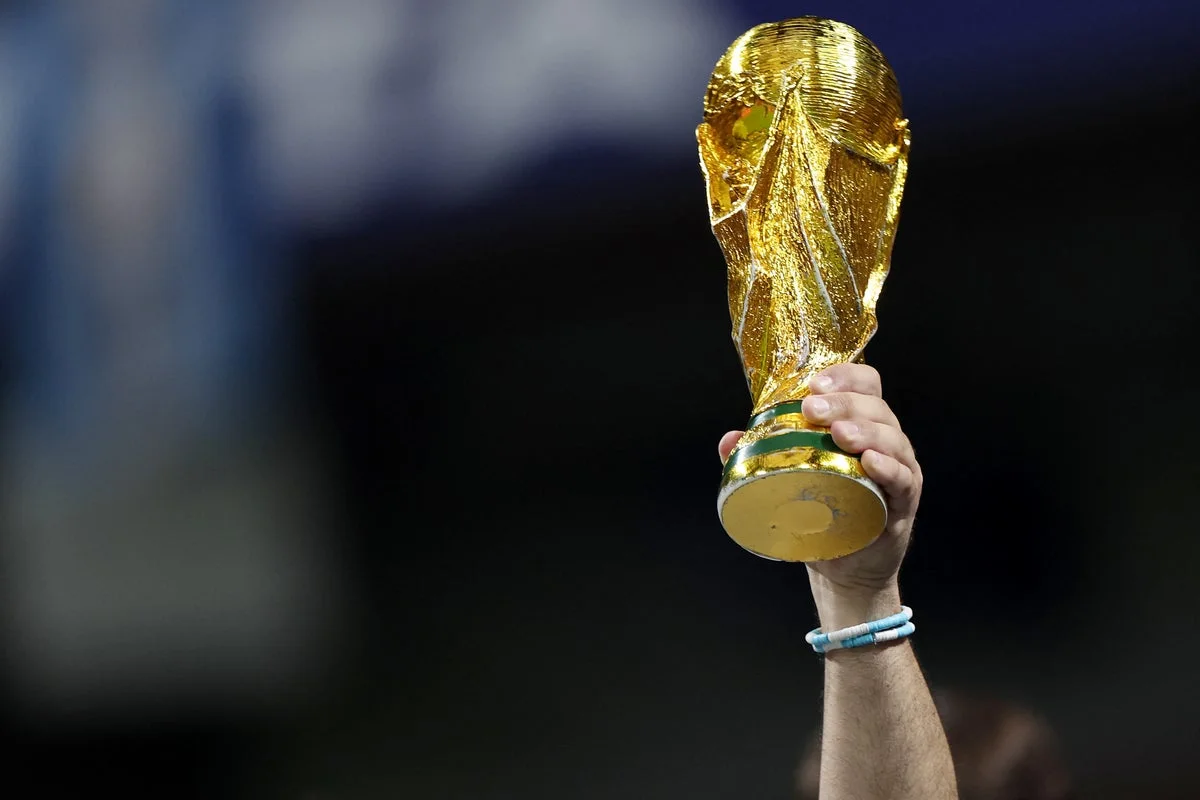
FIFA World Cup Trophy Origin Revealed as Final Approaches
The FIFA World Cup trophy, a symbol of global footballing supremacy, was conceived by Italian sculptor Silvio Gazzaniga with a singular ambition: to encapsulate the raw emotion of the sport.
His design sought to intertwine the athlete’s arduous struggle, the fan’s ecstatic jubilation, and the ultimate moment of victory into one dynamic, spiraling form, a vision that has since become instantly recognizable worldwide.
Advertisement
This Sunday, as either Spain or Argentina vie for glory in the 2026 World Cup final, the winning captain will have the honor of hoisting this coveted prize. But how did this iconic trophy come to be?
Its origins trace back to a studio in Milan’s historic Brera neighborhood, where Gazzaniga responded to an open competition from FIFA. The international governing body for football sought a new design after Brazil secured permanent ownership of the original trophy, the Jules Rimet, by clinching their third World Cup title in 1970, necessitating a replacement for future tournaments.
Gazzaniga’s now universally recognized design features two athletic figures, seemingly in motion, spiraling upwards from the base, supporting an orb that majestically represents the Earth. His son, Giorgio Gazzaniga, who was a teenager at the time of its creation, vividly recalled his father’s meticulous creative process.
Silvio Gazzaniga designed the World Cup trophy (AFP)
“When he started to design the cup, he was sketching a huge number of drawings and finally started to develop the idea to have the world and this symbol that it is like two DNA spirals, that are moving up,” he explained.
Advertisement
The elder Gazzaniga, a celebrated sculptor and prolific trophy designer who passed away in 2016, worked for G.D.E. Bertoni Srl and was also responsible for crafting other prestigious awards in the world of sport, including the UEFA Cup and the European Super-Cup.
The journey to the current trophy was not without drama, marked by the tumultuous and somewhat infamous history of its predecessor. The inaugural World Cup in 1930 saw the introduction of the Jules Rimet Trophy, which depicted the winged Greek goddess Nike, a classical symbol of victory.
This trophy, named after the tournament’s founder, was famously stolen not once, but twice.
Its first disappearance occurred in 1966 while on public display in England, sparking a national hunt that led to its recovery by a dog named Pickles, found beneath a hedge in South London, according to FIFA’s official records.
Advertisement
However, after Brazil gained permanent possession following their third triumph, it was stolen again in 1983 from the Brazilian Football Confederation headquarters. This time, it was never recovered and is widely believed to have been melted down, leaving a significant void that Gazzaniga’s creation would ultimately fill.
Amid more than 50 submissions for the new trophy, Gazzaniga’s proposal stood out significantly from the competition. He was the only designer to present a full, three-dimensional model, which allowed the jury to fully appreciate both its intricate form and the powerful narrative it conveyed, as his son explained.
Giorgio Gazzaniga further elaborated on the profound symbolism embedded within the sculpture, detailing its layers of meaning: “There is the world, which stands above all else, there is the athlete’s exertion, there is the athlete’s movement within the metal, and the athlete’s body is rough, rugged, for it has suffered, had to fight, and struggled for victory.”
He added, with a sense of pride, “That victory is expressed through arms that resemble the wings of Victory, capturing not only the athlete’s triumph but also the jubilation of the fan.”
The Jules Rimet Trophy was stolen twice (AFP/Getty)
The Gazzaniga family has meticulously preserved his legacy, maintaining his original office at a new location on the outskirts of Milan, complete with original drawings, the prototype submitted to FIFA, and a wax cast, offering a tangible glimpse into the creation of a global icon.
Advertisement
Despite its immense value and symbolic weight, World Cup winners do not get to keep the original trophy permanently.
The official prize, standing 36 centimeters (14 inches) tall and meticulously cast in 18-carat gold with a base featuring two rings of green malachite symbolizing the playing fields, is only held temporarily by the victorious nation for celebrations.
Following the tournament, the original returns to FIFA’s secure Swiss headquarters, where it is carefully kept between World Cups. The triumphant team, instead, brings home a gold-plated replica to commemorate their historic achievement. FIFA’s policy now dictates that even nations that achieve the rare feat of winning three World Cups no longer retain the original trophy permanently, ensuring its continuous journey across tournaments.
Gazzaniga’s enduring design has now graced 14 World Cups, becoming an integral part of the tournament’s identity.
Advertisement
FIFA has confirmed its continued use will extend at least until the 2038 tournament, a testament to its timeless appeal and universal recognition. Giorgio Gazzaniga still vividly recalls the emotional moment of the 1974 World Cup final, the very first time his father’s creation was presented on the global stage, as West Germany triumphed over the Netherlands.
“The real explosion of joy came when the German team raised the cup in Munich and the whole stadium erupted,” he recounted, reflecting on the profound impact of that moment. “That was the moment an object became an icon.”