
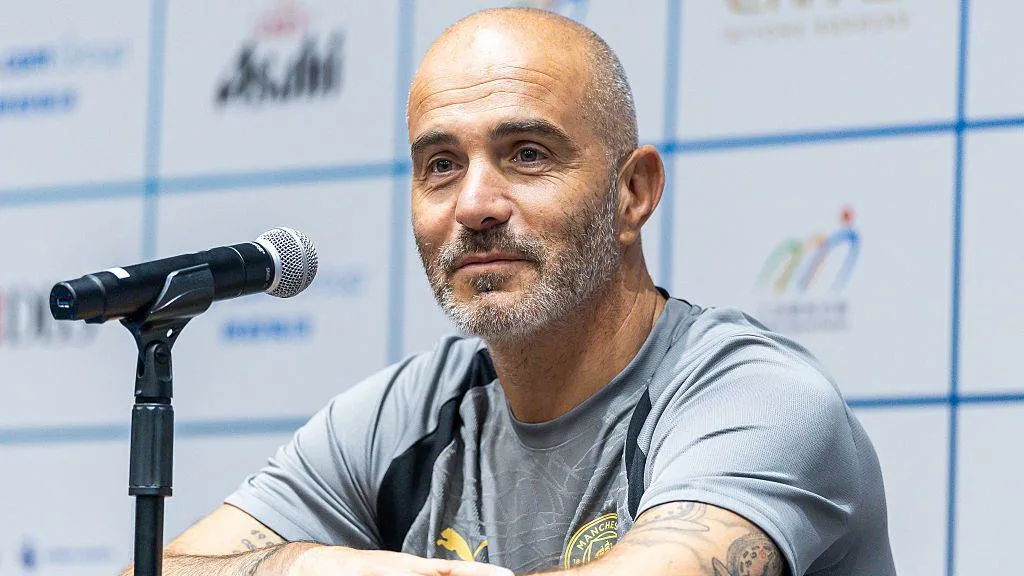
Headline: Manchester City Under Enzo Maresca: A New Approach with Familiar Principles
Manchester City manager Enzo Maresca faces the challenge of succeeding Pep Guardiola, who enjoyed a remarkable 10-year tenure at the club. His appointment hints at a continuation of the tactical strategies employed by his predecessor. However, Maresca, while influenced by Guardiola, is beginning to showcase his distinct style during City’s pre-season matches.
To grasp the nuances of Maresca’s vision, one must first consider Guardiola’s methods. Some incorrectly believe that Guardiola adhered to a single tactical framework. In fact, while he maintained core principles such as maximizing ball possession and implementing positional play, he often adapted his systems. Long-time assistant Domenec Torrent articulated positional play as the arrangement of players on the field, crucial for both maintaining possession and defending against counter-attacks.
Maresca’s City demonstrates these principles, achieving 64% possession in their initial outing against Inter Milan. His tactics involve players occupying designated positions rather than roaming freely, underscoring his advocacy for structured positional play. Notably, during attacks, Maresca’s approach ensures that four or five players remain positioned for defensive coverage, maintaining what is termed ‘rest defence’.
Maresca’s tactical configuration features a 3-2-2-3 formation, reminiscent of his strategies at Chelsea. This structure keeps three defenders at the back who can advance with the ball while also maintaining defensive width. Ahead of the defense, two midfielders facilitate ball movement, providing protection and executing rapid counter-presses when possession is lost. In recent matches, Maresca has given one midfielder—Tijjani Reijnders—more freedom to attack, while Matteo Kovacic anchors the midfield.
Central to Maresca’s system is the role of wide wingers. They are instructed to stay high and wide, an approach stressed after a challenging game against K-League All-Stars. Player Nico Gonzalez noted the emphasis on engaging wingers due to their quality. This marks a shift from Guardiola’s final season when wingers operated more narrowly. Instead, Maresca’s plan recalls the tactics used with players like Raheem Sterling and Leroy Sane in 2017.
Maresca’s demand for width extends to pressing strategies. During his coaching stint at Chelsea, he relied on a high man-to-man press, but in pre-season, City has employed a more zonal defensive approach, maintaining a shape of 4-2-4 before pressing opponents selectively. This adjustment accounts for an evolution in how teams build attacks against pressing systems.
Overall, Maresca’s tenure begins with notable similarities to Guardiola’s era, particularly in terms of identity and core principles. The 3-2-2-3 shape played a key role in City’s success during previous seasons, as did the use of wide wingers and overlapping full-backs. While Maresca establishes his vision, echoes of the past remain as the team embarks on a new chapter.
Manchester City manager Enzo Maresca has no easy task following Pep Guardiola’s impressive 10-year act.
For many, his appointment suggests a continuation in tactical approach.
But Maresca, despite clearly being inspired by his former mentor, has his own style and one which we have started to see emerge across City’s pre-season.
Advertisement
Maresca’s principles mirror Guardiola
To understand Maresca’s City we need to provide some context about Guardiola’s.
Guardiola, by some, is mistakenly thought to be strictly married to a singular approach. While Guardiola had principles he stuck to throughout his career, he did not stick to one system.
These principles included keeping as much of the ball as possible, as far away from his team’s goal and as close to the opponent’s goal. His game was also founded on the basis of positional play.
Domenec Torrent, a long-time assistant of Guardiola’s, offered a nice definition of positional play, describing it as “how you place yourself in relation to others on the field when you have the ball, and where you should be so that you can continue pressing when you lose it”.
Advertisement
The coach implements tactics based on the positions of players in the hope of giving their team an advantage.
The end of Torrent’s definition highlights another key Guardiola principle, the idea of good rest defence, referring to team-mates behind the ball when their team attacks, ready to defend counter-attacks.
Maresca’s City also embody these principles, evident by their 64% possession in their first game against Inter Milan.
On the ball, players in Maresca’s set-up play in clearly defined positions rather than moving around the pitch freely. It is obvious the Italian, like Guardiola, is a champion of positional play.
Advertisement
So we have seen Maresca’s City leave four or five players – the three defenders and the holding midfielders – behind the ball whilst they attack, ensuring the team maintain a good ‘rest defence’.
Maresca’s City have a solid shape. The five players outlined in yellow are capable of creating attacks while being positioned in a way that provides protection from dangerous counter-attacks [BBC]
But his system differs from his predecessor…
On the ball, Maresca sets City up in a 3-2-2-3 shape, a shape he used while managing Chelsea.
This rather rigid positional style of play keeps three defenders in the first line, capable of playing with the ball, while being able to cover the width of the pitch defensively.
In front of them, two midfielders help progress the ball, screen the defence, and counter-press quickly if the ball is lost.
Advertisement
In the midfield pairing, we have seen Maresca give license to one midfielder to contribute to the attack at times – most recently Tijjani Reijnders, linked with a move away, with Matteo Kovacic sitting at the base of midfield.

City’s 3-2-2-3 shape in possession is clearly seen here. Against K-League All Stars XI, Rico Lewis inverted from right back into midfield to help City move from a back four into this attacking shape [BBC]
Why City’s system depends on wide wingers
Ahead of this 3-1 or 3-2 base, wingers are asked to stay high and wide, resisting the urge to leave their position. This is arguably the important part of Maresca’s system at City so far.
Nico Gonzalez, speaking after a gruelling game in the heat against K-League All-Stars, provided valuable confirmation.
“I think the idea is clear,” he said. “We try to arrive to the wingers. We have a lot of quality in wingers.”
Advertisement
In Guardiola’s final season, City often used wingers in a narrow fashion, something he explained as being a result of the quality of the players he had available.
But Maresca’s system looks to return to using wingers wide – a throwback to the work of Raheem Sterling and Leroy Sane in 2017.

Here, against Atletico Madrid, we see City building up with a 3-1 base marked in yellow. Highlighted in white are both wingers, Antoine Semenyo on the left and Savinho on the right, playing high and wide [BBC]
Guardiola’s friend and journalist Marti Perarnau spoke to the former City coach about his use of wide wingers during the 2016-17 season.
As noted in Perarnau’s book, The Pep Revolution, Guardiola said: “It’s a difficult process. You can’t just talk to [the wingers] and expect everything to happen.
Advertisement
“My first challenge is to convince [the wingers]. Just stay there on the wing, stay wide. Bide your time, be patient and your moment will come.
“Then, when you do get your chance, think about it, how many opponents am I going to have to get past?
“The answer? Just one.
“We’ve come up with this whole strategy so that you, the winger, only have to dribble past one man and sometimes there will be nobody in your way. On the other hand, if you stop paying attention and drift into the middle, how many will you have to get past? Four!”
Guardiola, of 10 years ago, perfectly describes the logic and strategy behind Maresca’s current system, and one that still works.
Advertisement
Across pre-season, Antoine Semenyo, stationed on the flank, was arguably City’s standout player, receiving the ball with time and space to run at his full-back. These situations commonly resulted in him arriving close to the box, cutting it back for a forward to tap the ball in, behind the opposition’s defence.
For the players behind the winger, the game is simplified into looking to find this repeatable situation.
How Maresca uses the centre of the pitch
As heavy as this approach is on dominating through the winger, this does not mean the players infield don’t play a valuable role.
If opponents double up on dangerous wingers, the logic is that space will open up inside. This is where attackers comfortable in small spaces, like Phil Foden and Rayan Cherki, may be able to impact games.
Advertisement
Maresca has asked Josko Gvardiol to move from left-back to a left attacking-midfield position when City have the ball, helping form the box shape in midfield.
Both he and Nico O’Reilly have shown an impressive ability to contribute to goals in the final third starting at full-back before arriving into the box. This is a pattern that we will likely see from City this season.

Josko Gvardiol has commonly pushed up from left-back into this central attacking position under Maresca [BBC]
A continuation of City’s 4-2-4
Out of possession is where we see the biggest changes from Maresca when compared to his time at Chelsea.
At Chelsea, Maresca mainly used a man-to-man press high up the pitch. In pre-season we have seen City defend high up the pitch but in a more zonal fashion – something City did last season.
Advertisement
City’s starting shape here has looked like a 4-2-4 before players spring to press certain opponents when the moment is right.

City’s front four hold their shape in a zonal fashion to begin with before Foden presses the goalkeeper [BBC]
Reflecting on how the game has changed in pre-season, Maresca said: “Usually the team that was defending found the solution by going man-to-man. Now the teams that try to build up are trying to find solutions against man-to-man. I don’t know when but there is going to be a bit of change.”
And his change in defensive approach appears to be trying to ensure his side are ready for teams who are preparing to play against man-to-man presses more often.
In pre-season, this has been the weakest part of City’s system with players, often in midfield or at full-back, having to cover large distances, leaving gaps in their defensive shape.
Advertisement
Like with any defensive approach that involves an element of pressing, this improves with time, as players better understand the press, as well as when physical condition improves.
But this was a part of the game Guardiola tweaked often last season, struggling to land on something he was completely happy with.
A unique yet familiar next chapter
There is benefit in Maresca’s hire following Guardiola because it provides a sense of familiarity, particularly in the team’s identity and their principles.
The 3-2-2-3 shape was the shape City won the treble with. The high and wide wingers, given multiple one-against-one situations per game, and the focus on cut-backs were seen in City’s centurion season.
Advertisement
Meanwhile, the use of full-backs moving infield and attacking the box were obvious in City’s 2025-26 campaign – as was their 4-2-4 defensive shape.
Maresca’s system is its own but interestingly there are references to City’s last decade as the club look to begin a new chapter.
[/gpt3]