Headline: Violence Erupts at European Football Matches Amidst Rising Political Tensions
Across Europe this week, the beautiful game transformed into a setting for disturbing acts of violence, as the pattern of politicized aggression in soccer escalates. In Marseille, Sunderland, and Batumi, political tensions and extremist gestures erupted into chaos, with open brawls breaking out in the stands. While matches proceeded and points were assigned, harrowing scenes of bloodied fans, metal pipes, and pepper spray overshadowed the sporting events. What should have been ordinary Europa League nights turned into stark reminders of how swiftly global politics can disrupt the atmosphere of a stadium.
Marseille: Mob Violence, Failed Policing, and Unforgivable Attacks
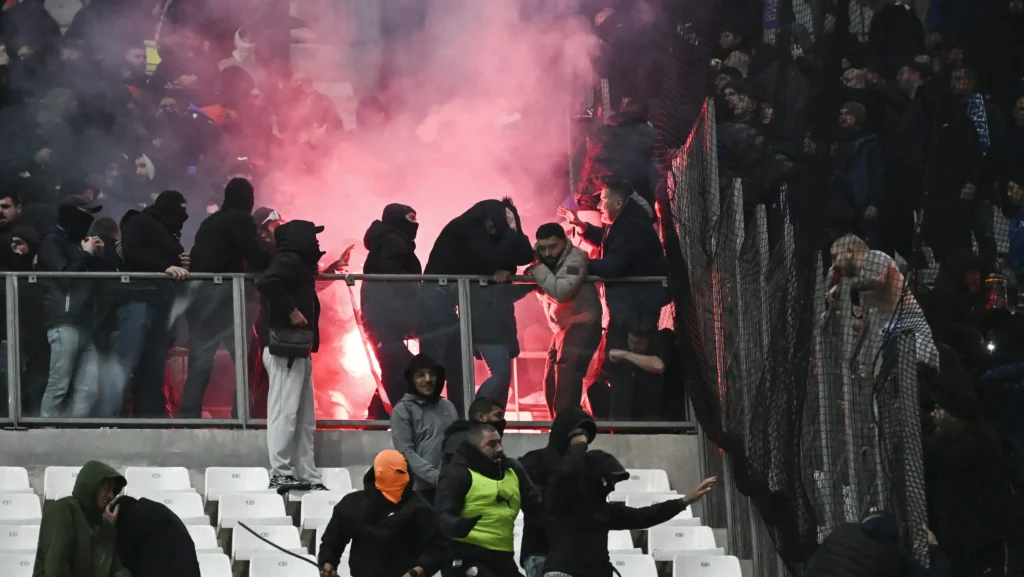
As the clock ticked down to kickoff at the Stade Vélodrome, hundreds of Olympique de Marseille ultras charged toward the Levski Sofia away section, armed with metal pipes, belts, and flares, clashing violently with visiting Bulgarian supporters. Video footage that circulated afterward showed masked home fans attacking a woman and unleashing violence on trapped Levski fans. Eleven Bulgarian supporters suffered injuries, with six requiring hospitalization, including one fan who suffered a brain hemorrhage and a fractured skull. Two French riot police officers also sustained minor injuries.
Reports varied on what instigated the violence. A Reuters photographer and French media indicated that Levski supporters displayed Nazi salutes and other provocations in the away section, while Levski officials claimed their fans were the initial targets. Following their team’s 1-0 victory, Marseille supporters chanted “Siamo tutti antifascisti” (“We are all antifascists” in Italian), and French authorities have opened investigations into aggravated assault and incitement to hatred. President Emmanuel Macron condemned the violence “with the utmost force.”
If Levski fans did indeed perform Nazi salutes, they warrant severe penalties, but these should come from UEFA, not an enraged crowd. Regardless of circumstances in the away end, the subsequent armed attack on supporters, including an assault on a woman in the stands, crossed all boundaries of acceptable conduct. Marseille’s inability to provide proper segregation and policing at their stadium makes them directly responsible for the chaos. UEFA must impose stringent sanctions on Marseille and hold all clubs involved in this week’s turmoil accountable to prevent future incidents from spiraling out of control.
Sunderland: Banned Ultras Slip In and Chaos Follows
In northern England, the Polish side Jagiellonia Białystok faced UEFA restrictions barring their supporters from attending their Europa League match at Sunderland due to earlier incidents of crowd trouble tied to a previous meeting with Levski Sofia. Despite the ban and Sunderland’s attempts to halt suspicious ticket sales, approximately 50 to 100 Polish fans successfully infiltrated the home North Stand.
Fights erupted early in the 1-1 draw as police intervened, resulting in seven arrests, including three for assaulting officers. Eyewitnesses described scenes of panic as some away fans began throwing punches, with reports also suggesting that some of the infiltrators performed Nazi salutes. Sunderland criticized Jagiellonia for not cooperating and launched an investigation into how banned supporters procured tickets. Meanwhile, Jagiellonia argued that UEFA only restricted an official away allocation and asserted that the individuals present were not part of an organized group. Nonetheless, the implementation of a stadium ban proved ineffective as political and nationalist animosity easily made its way through the turnstiles.
Batumi: Pro-Palestine Banner Triggers Police Clash
In Georgia, a geopolitical conflict disrupted a match entirely. UEFA had previously relocated Beşiktaş’s home game against Israeli club Hapoel Be’er Sheva from Istanbul to Batumi for security reasons, and tensions were palpable before the match as Beşiktaş players refused to shake hands with their opponents. In the 26th minute, play stopped for about half an hour after Beşiktaş supporters displayed a large banner proclaiming “Revolt against the occupation, freedom for Palestine,” alongside Palestinian flags and anti-Israel chants.
Georgian riot police entered the stands and used pepper spray as seats were torn out and thrown, resulting in one supporter being carried out on a stretcher. Sixteen Beşiktaş fans were detained, and three members of the Georgian interior ministry suffered injuries. Authorities in Georgia claimed the violence erupted before any flags appeared and insisted that UEFA delegates, not police, were responsible for removing the banners. However, Beşiktaş and Turkish officials strongly disputed this narrative, accusing police of employing “disproportionate” force. Following diplomatic intervention from President Recep Tayyip Erdoğan, all 16 detained supporters were eventually released. Beşiktaş went on to win the match 2-1, and UEFA has assigned ethics and disciplinary inspectors to investigate the incidents in Marseille and Batumi.
A Fractured World Spills Onto the Pitch
These violent incidents are not isolated; they reflect a larger global divide manifesting itself on the football field. In a highly polarized environment, stadiums have become convenient venues for settling political scores. Young athletes on the pitch often find themselves distanced from the conflicts their supporters embody—many even oppose their governments’ policies—yet it is the players and families who bear the brunt through disrupted games, injuries, and impending stadium bans.
Violence achieves nothing. Nazi salutes are unacceptable. Assaulting women and jeopardizing families in the stands is intolerable, and the destructive actions against law enforcement and property undermine the integrity of the sport. When politics meddles with the terraces, football loses its essence as a unifying force. UEFA’s disciplinary team and national prosecutors are armed with video evidence; they must enact strict, definitive penalties to deter future incidents before the cycle of violence repeats.