Hansi Flick’s Tactical Changes Propel Barcelona to Victory Over Atletico Madrid
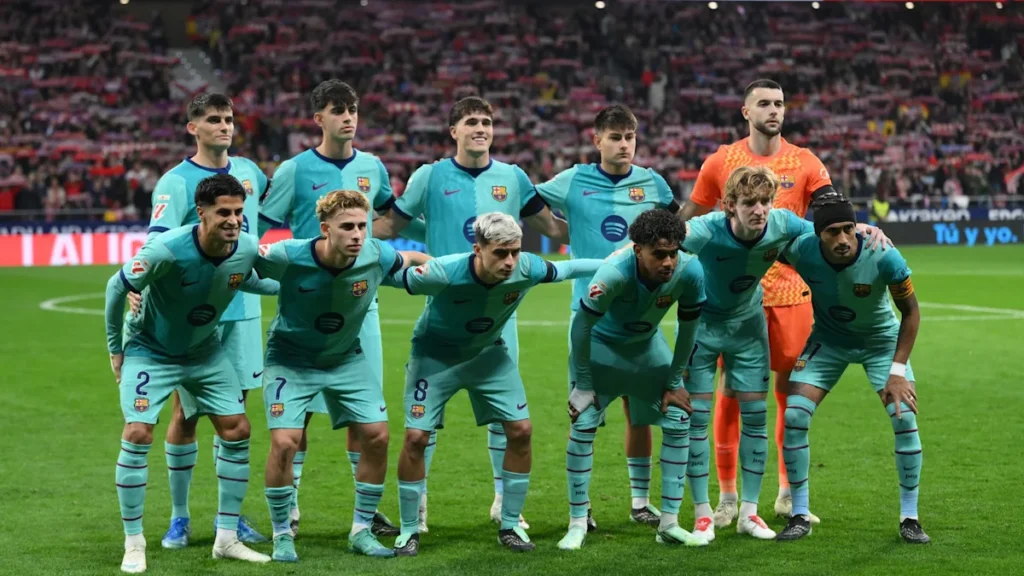
Barcelona’s recent 2-1 victory against Atletico Madrid showcased Hansi Flick’s impressive tactical awareness. The manager earned praise for guiding his team through a challenging first half by making crucial adjustments that altered the match’s direction.
One of Flick’s key decisions involved introducing Frenkie de Jong at right-back during halftime, a move that proved pivotal in reshaping Barcelona’s build-up play. His arrival helped regain midfield control that was sorely lacking in the first half.
Advertisement
Barcelona appeared vulnerable during the initial 45 minutes as Atletico Madrid exploited defensive weaknesses and disrupted their midfield structure to create multiple attacking opportunities.
Fermin Lopez’s equalizer just before halftime offered some respite but did not mask the issues that Flick needed to tackle. The manager recognized that instead of sticking to the original tactics and banking on improvement, decisive action was necessary for the team’s success.
De Jong’s Shift to Right-Back Turns the Tide
In the first half, Atletico effectively imposed their strategy, employing aggressive pressing and smart possession use to stifle Barcelona’s attempts to take control of the game.
Advertisement
Pablo Barrios and Koke proved instrumental in midfield, minimizing the impact of Marc Bernal and Pedri, while Alex Baena and Giuliano Simeone took advantage of spaces within Barcelona’s defense.
Frenkie de Jong briefly played at the right-back against Atletico Madrid. (Photo by David Ramos/Getty Images)
Barcelona’s struggles did not end with possession; they also found it challenging to press effectively, allowing Atletico to advance into threatening positions.
Flick acknowledged these shortcomings, stating,
“In the first half we were too far off our opponents and couldn’t press effectively. But the match lasts 90 minutes: the first half wasn’t perfect, but the second half was.”
Advertisement
The equalizer from Fermin allowed Barcelona to regroup, but it was clear to Flick that further adjustment was necessary.
Instead of opting for the more typical substitution of bringing on Eric Garcia, he deployed De Jong to right-back in place of Brian Farinas, an unusual choice given De Jong’s usual position.
This strategy addressed multiple issues by enhancing composure in possession and providing better options to navigate through Atletico’s pressure.
Advertisement
Importantly, De Jong’s role extended beyond that of a traditional full-back; his positioning contributed positively in central areas and facilitated possession progression, allowing Barcelona to find attacking routes through Atletico’s defense.
Further Defensive Changes Enable Barcelona to Regain Control
With De Jong’s influence, Pedri saw an increase in his effectiveness on the ball, allowing offensive players to find more dangerous spaces between Atletico’s defensive lines.
Advertisement
This shift played a crucial role in the build-up to Barcelona’s winning goal.

Hansi Flick’s performed a tactical masterclass against Atletico Madrid. (Photo by Julian Finney/Getty Images)
The match statistics underscored the transformation, with Barcelona holding 63% possession and registering 19 shots, compared to Atletico’s 37% possession and nine attempts. While De Jong’s position change alone may not account for the improvement, it illustrates how the dynamics shifted following halftime.
Flick’s strategic management did not wane after Barcelona took the lead. His timely substitutions focused on maintaining defensive solidity while preserving ball control.
Advertisement
Midway through the second half, Andreas Christensen substituted for Joao Cancelo, bolstering the defense. Soon after, Eric Garcia entered for Bernal, who had been cautioned, allowing De Jong to revert to his natural midfield role.
This adjustment proved significant for the match’s tempo and showcased Flick’s willingness to innovate, despite the inherent risks. As the game concluded, Barcelona’s defensive alignment comprised Eric Garcia, Pau Cubarsi, Christensen, and Gerard Martin.
In summary, while Hansi Flick initially faced challenges, his capacity to pinpoint weaknesses in his strategy and implement effective adjustments during the game significantly influenced the outcome at the Metropolitano. Against such a tactically demanding opponent as Atletico, this adaptability was as crucial as the talent of the players who secured the victory.