
Argentina Triumphs Over England 2-1, Sparking Controversy with Political Message
The Argentina national team celebrated wildly after a dramatic 2-1 comeback win over England in the semifinal of the 2026 FIFA World Cup.
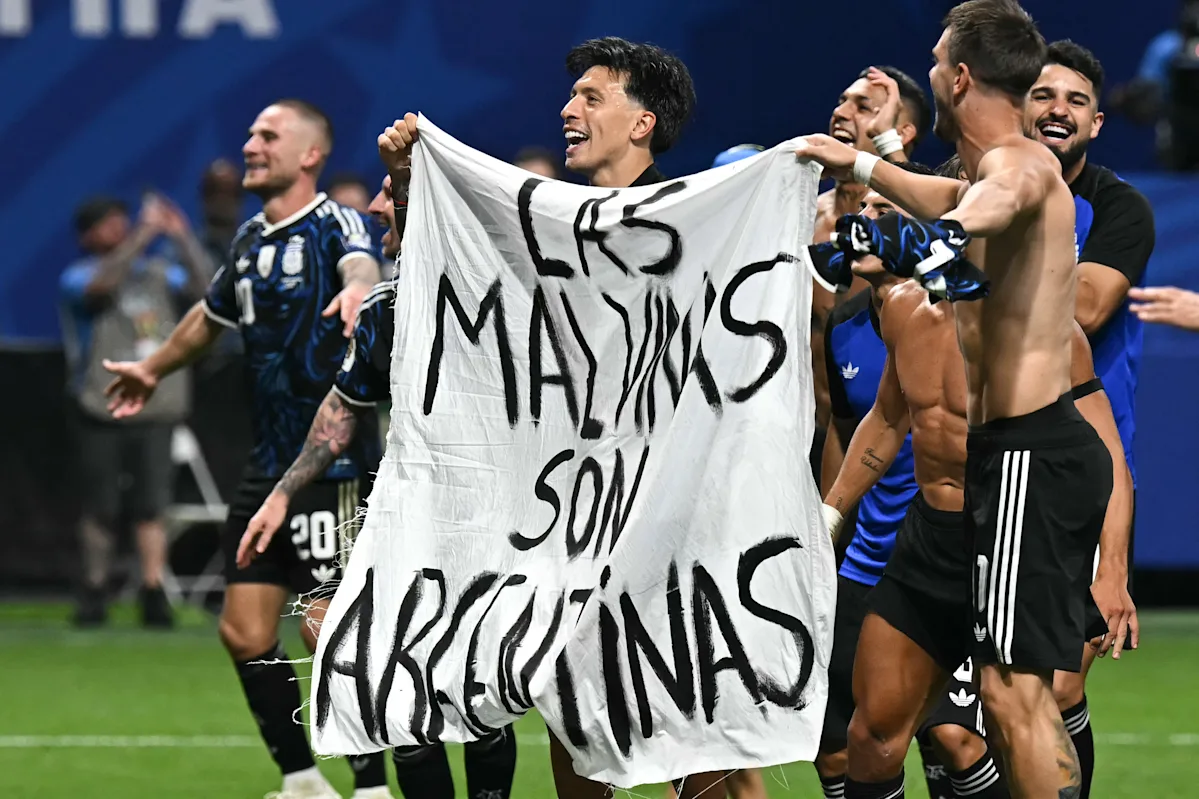
After the final whistle, the players took a banner from the stands and spread it out on the pitch with the phrase: “The Malvinas are Argentine.”
Advertisement
The demonstration, however, runs up against FIFA’s strict rules against political messages in football.
What does the regulation say?
Article 17 (paragraph two) of the FIFA Disciplinary Code holds federations responsible for the use of political, ideological, religious, or offensive messages.
The range of possible punishments for the Argentine Football Association (AFA) includes:
-
Formal warning or caution.
-
Stripping of a title (in extreme cases).
The financial hit
For a first offense involving this type of banner, the fine ranges from R$31,000 (minor cases) to R$62,000 (serious cases).
The amounts increase by 100% for each repeat offense.
Disrespect toward the English anthem
Advertisement
The stands can also cause headaches.
Before kickoff, the South American fans drowned out the playing of England’s anthem by chanting, “If you don’t jump, you’re English.”
FIFA provides for specific punishments for disturbances during anthems, with fines ranging from R$31,000 to R$47,000 even for a first occurrence.
Historical Context
The rivalry between Argentina and England goes beyond the pitch.
Argentina’s protest with the banner “The Malvinas are Argentine” has once again drawn global attention to a centuries-old territorial dispute that culminated in a war in 1982.
Geographically, the islands are just 550 kilometers off the coast of Argentina, but 12,800 kilometers from Great Britain.
Advertisement
However, the two countries view the territory in completely different ways (even down to the name of the capital: Puerto Argentino for South Americans and Stanley for the British).
The current situation
The islands, called the Falkland Islands by the British, are a British Overseas Territory.
They have their own local government, but London is responsible for defense and part of foreign relations.
Argentina, however, rejects British administration, arguing that the archipelago has been under illegal occupation since 1833.
The country claims to have inherited rights over the territory from Spain after its independence in 1816.
Advertisement
What do the UN and the local population say?
The international community treats the matter as an unresolved diplomatic issue:
The UN’s position: The United Nations does not declare who the islands belong to. Since 1965, it has formally recognized that a sovereignty dispute exists and has called for a peaceful resolution between the two countries.
The will of the residents: In 2013, a referendum asked inhabitants whether they wished to remain a British territory. The result was overwhelming: 99.8% said “yes” (only 3 people voted against it). The United Kingdom uses this as proof of the people’s right to self-determination. Argentina, meanwhile, rejects the validity of the referendum, arguing that the current population was “implanted” by British colonizers.
Advertisement
The Falklands War (1982)
The diplomatic dispute turned into armed conflict on April 2, 1982.
The beginning: Argentina’s military dictatorship at the time, led by General Leopoldo Galtieri, invaded and occupied the islands in an attempt to impose sovereignty.
The response: British Prime Minister Margaret Thatcher reacted by sending a massive military task force to the South Atlantic.
The outcome and the victims: After 74 days of intense fighting on land, at sea, and in the air, the Argentines surrendered on June 14, 1982. The war left 907 dead in total (649 Argentine military personnel, 255 British personnel, and 3 local civilians).
Advertisement
Political consequences: The humiliating defeat accelerated the end of the military dictatorship in Argentina. On the other hand, the victory secured Margaret Thatcher’s reelection and strengthened her position in the United Kingdom.
Football in the middle of the conflict
During the war, anti-British sentiment in Argentina was so strong that English schools were vandalized and streets were renamed. Football, however, remained untouched.
Historic clubs, founded in the late 19th century under the influence of British engineers and workers employed on Argentina’s railways, kept their English names. This is the case with giants such as River Plate, Boca Juniors, Racing Club, and Newell’s Old Boys.
Advertisement
On the pitch, however, the bitterness became fuel.
Four years after the war, in 1986, Diego Maradona made history by eliminating England from the World Cup with two emblematic goals (including the famous “Hand of God”).
Forty years later, in 2026, Argentina repeats its victory over the English at a World Cup, reviving the memory of the Malvinas on the sport’s biggest stage.