
Controversies Erupt as 2026 World Cup Unfolds in the U.S.
The 2026 World Cup has generated a mix of excitement and controversy. While the tournament has showcased thrilling soccer, it has also sparked significant outrage.
Issues range from contentious on-field decisions influenced by VAR reviews to off-field visa complications. FIFA faces scrutiny for its responses to various challenges, including those brought on by weather conditions.
Advertisement
Here are some key controversies that have emerged during the World Cup since its commencement.
Omar Artan Denied Visa
The controversies began even before the tournament kicked off when Somalian referee Omar Artan was denied entry into the United States. His visa denial stemmed from the U.S. government’s immigration crackdown under President Donald Trump’s administration. A travel ban signed in 2025 prohibits entry from nearly 40 countries, including Somalia.
Artan, an accomplished referee with a wealth of experience in African soccer, was ultimately sent back home but received a warm welcome from supporters in Somalia. He would have made history as the first referee from Somalia to officiate in a World Cup match.
Omar Artan is greeted after returning home to Somalia.
(REUTERS / REUTERS)
FIFA stated that, as with previous tournaments, visa matters fall under the jurisdiction of host countries, with FIFA president Gianni Infantino noting that they “don’t control everything.” (FIFA later compensated Artan fully for the situation.)
Advertisement
Iran’s Treatment Amid War with the U.S.
The Iranian national team faced a challenging environment while competing in the U.S., a country engaged in military action against Iran. The team’s experience was marred by logistical challenges during the tournament.
Initially set to be based in Arizona, Iran relocated to Tijuana, Mexico, fearing visa issues. While the team successfully entered both countries, several coaches and staff encountered visa rejections. Following their group matches in the U.S., Iran had to return to Tijuana, resulting in an exhausting travel schedule.
After a 1-1 draw with Egypt, captain Mehdi Taremi revealed that Infantino visited their locker room, assuring them improvements were forthcoming, but Taremi found no changes materialized during the competition.
Advertisement
“It’s a disaster World Cup,” Taremi stated.
Iran narrowly missed progression to the knockout stage, finishing one spot short due to a series of unfortunate draws.
FIFA’s Political Elements Policy
FIFA maintains strict regulations against the display of political statements by countries and fans, yet this policy has ignited disputes during the tournament.
Prior to the World Cup, Haiti was compelled to revise its jersey designs, which included depictions of fighters from the Battle of Vertières, a pivotal moment in their history. FIFA deemed the imagery too political, a point contested by a Haitian representative.
Advertisement
Some Iranian fans attempted to bring pre-revolutionary flags into games, displaying the golden Lion and Sun emblem instead of the Islamic Republic’s symbol. Although some managed to smuggle these flags inside, many were confiscated at the gates due to FIFA’s regulations.
Argentina has seemingly challenged the limits of FIFA’s policy: After defeating England, the team displayed a banner related to the Falkland Islands, which remain a contentious issue between Argentina and the UK. As of now, FIFA has not issued any penalties regarding the banner.
The Hydration Breaks
The introduction of hydration breaks has sparked discontent among players and coaches alike throughout the tournament. These three-minute pauses in each half have drawn boos from fans, primarily seen as opportunities for additional advertising during broadcasts.
Advertisement
Norway’s coach Ståle Solbakken criticized the breaks as “unnecessary,” while French manager Didier Deschamps described them as dividing games into “almost four quarters.” Netherlands captain Virgil Van Dijk argued for a more situational approach to assessing the need for such breaks.

France’s Désiré Doué cools off during a hydration break on a hot day in Foxborough, Massachusetts.
(Michael Regan – FIFA via Getty Images)
As the tournament progressed, players began to appreciate the breaks more during hotter matches, such as the quarterfinal between England and Norway. However, in cooler conditions or indoor games, the breaks have faced criticism.
Jérémy Doku Leaves Tournament for Birth of Child
Belgian forward Jérémy Doku stepped away from the team during the group stage to witness the birth of his first child. His absence saw him miss Belgium’s second group match against Iran, which ended in a scoreless draw, in which Belgium was reduced to 10 men.
Advertisement
His decision drew mixed responses, with local media criticizing him for prioritizing family over national duty. Doku rejoined the squad before Belgium’s final group stage game against New Zealand, which they won comfortably.
Canada’s match against Qatar took a turn when Assim Madibo’s tackle broke the leg of Canadian midfielder Ismaël Koné. The injury required immediate medical attention, and Madibo was subsequently shown a red card following a VAR review. Canada’s head coach Jesse Marsch reported that Madibo later visited Koné in the locker room to apologize before he was taken to the hospital.
Following a review of the incident, the FIFA disciplinary committee handed Madibo a five-match ban for serious foul play. As Qatar did not progress past the group stage, his suspension will continue into future matches.
Advertisement
Mexico’s Controversial Chant Returns
A controversial chant from Mexican fans resurfaced during the group stage, echoing the anti-gay slur as opposing teams prepared for goal kicks while Mexico played Czechia.
This chant, which has persisted for 25 years, has already cost the Mexican federation substantial fines. Interestingly, FIFA did not immediately penalize the federation this time, and reports indicate that fans may have ceased using the slur after that match.
Ecuador Wins Despite Missed High Boot Foul
Ecuador faced a critical moment in their final group match against Germany, conceding an early goal due to a clear missed high boot foul from German midfielder Aleksandar Pavlović against Ecuador’s Pedro Vite.

Aleksandar Pavlović (L) goes for the ball with a high boot toward the face of Pedro Vite.
(picture alliance via Getty Images)
Despite this setback, Ecuador quickly equalized and secured a knockout stage berth with a strong second-half performance.
Advertisement
Paraguayan Broadcaster Has Credential Revoked
Broadcaster Jorge Chipi Vera faced consequences during the group stage when his credential was revoked following a profane outburst against FIFA amid Paraguay’s victory over Türkiye. His fury arose after referee Ivan Barton issued a red card to Paraguayan player Miguel Almirón for speaking with a Turkish player—a first-time application of a rule meant to combat racial abuse.
Vera labeled Barton a “thief” and condemned FIFA for “killing football,” though he later issued an apology.
FIFA Denies France’s Request to Wear Black Armbands
In the aftermath of his mother’s passing, French head coach Didier Deschamps missed the team’s final group stage game. To honor him, Les Bleus planned to don black armbands; however, FIFA denied this request.
Advertisement
There were also miscommunications surrounding a tribute: a moment of silence before France’s match against Norway was initially reported to honor Deschamps’ mother but later clarified to be in memory of victims from recent earthquakes in Venezuela.
Belgium Advances After Late Controversial Penalty
Belgium triumphed over Senegal 3-2 in the Round of 32, aided by a penalty awarded deep in extra time. Belgium rallied from a 2-0 deficit, netting two goals in quick succession within the last minutes of regulation.
Captain Youri Tielemans converted the decisive penalty in the 125th minute after being fouled in the box by Lamin Camara. The soft nature of the foul and the penalty’s timing incited much debate, although it capped off a remarkable comeback for Belgium.
Advertisement
FIFA Reverses Time Change for Mexico-England Game Amid Weather Concerns
Extreme weather has been a recurring theme in various host cities, with some summer conditions posing challenges. Ahead of the Round of 16 match between Mexico and England, thunderstorms threatened to disrupt the game, prompting discussions about postponing kickoff from 8 p.m. to noon.
Confusion arose over whether the time change would occur, leading Mexico head coach Javier Aguirre to call it a “kick in the stomach.” Ultimately, FIFA opted to maintain the original schedule, although the game experienced a one-hour delay due to weather, with England securing a 3-2 victory.
Advertisement
Germany Exits After Controversial Foul Call Leads to Penalty Shootout
Germany’s hopes were dashed in the Round of 32 against Paraguay when a stoppage-time goal was disallowed after VAR detected a foul by Waldemar Anton against the Paraguayan goalkeeper.
This contentious decision, viewed as somewhat soft, shifted the match to a penalty shootout, which Paraguay won, thereby eliminating Germany for the third consecutive tournament without reaching the Round of 16.
Advertisement
Folarin Balogun’s Red Card Suspension Deferred
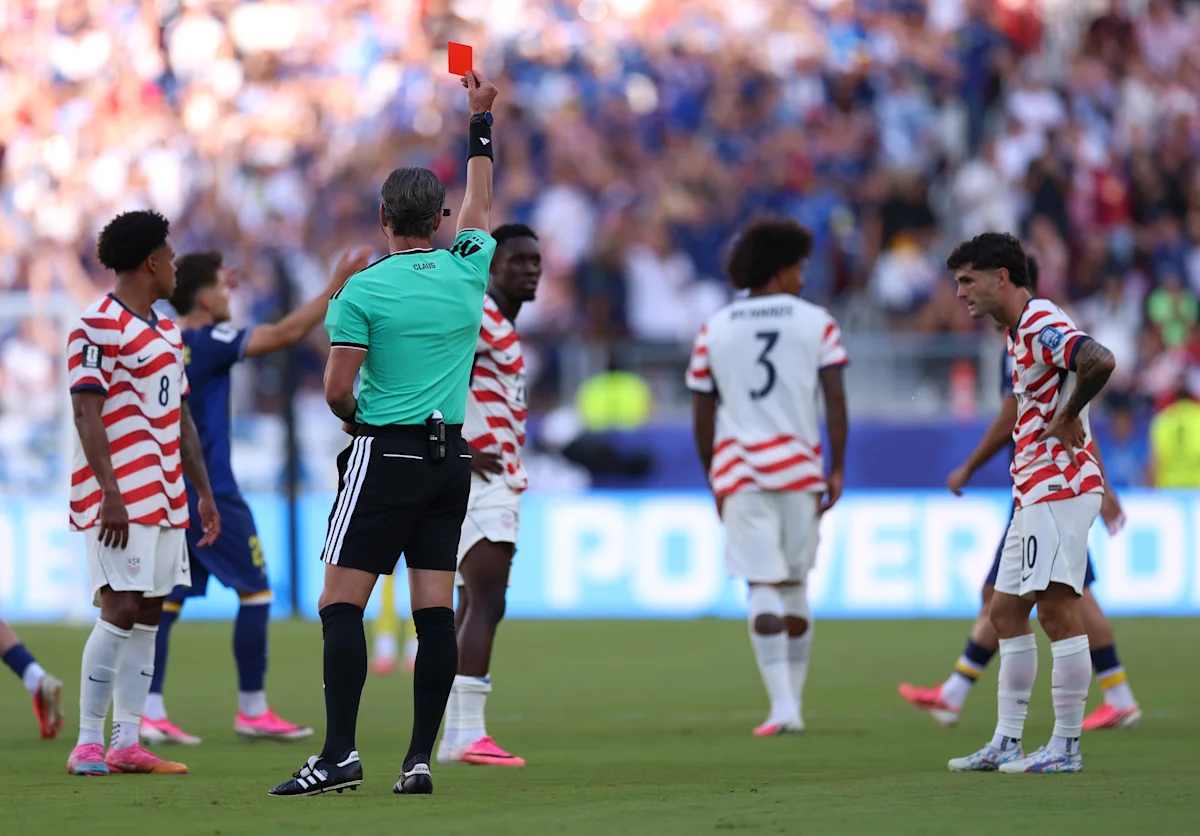
U.S. forward Folarin Balogun’s red card against Bosnia and Herzegovina has generated significant controversy. The decision, made after a VAR review, caused him to miss the USMNT’s Round of 16 clash with Belgium.
However, just before the match, Balogun’s one-match suspension was overturned, allowing him to play. The sudden change surprised even his teammates, raising eyebrows domestically and internationally alike. U.S. head coach Mauricio Pochettino stated the team had already been “punished enough” by ending the earlier game down a player.
President Trump later claimed he had personally reached out to FIFA president Gianni Infantino to request a review. The FIFA disciplinary committee justified their decision by imposing probation on Balogun for one year and fining him $40,000. Notably, this decision was reported to have been made unilaterally by FIFA disciplinary chair Mohammad al-Kamali.
An appeal from Belgium disputing the decision was rejected shortly before the game, but Balogun ultimately started against Belgium, although the U.S. lost 4-1, falling to Belgium.
Advertisement
Despite Pochettino’s assertion that the matters surrounding Balogun’s suspension would not excuse the team’s performance, Balogun acknowledged that the “outside noise” surrounding the situation was difficult to ignore.
Croatia Loses by a Hair
In a dramatic moment during the Round of 32, Croatia’s hopes of equalizing against Portugal were thwarted when a late goal was disallowed due to an offside call validated by VAR.
The disallowed goal, scored by Joško Gvardiol, followed a lengthy buildup involving potential offside on Ivan Perišić’s long pass. While Perišić’s pass was onside, a microchip confirmed that another player, Igor Matanović, had made contact with the ball while offside.
Advertisement
This ruling denied Croatia the opportunity to tie the game, resulting in a narrow 2-1 defeat against Portugal.
Egypt Cites ‘Injustice’ in Loss to Argentina
Following Argentina’s 3-2 victory over Egypt in the quarterfinals, Pharaohs’ head coach Hossam Hassan expressed concerns of unfairness, claiming that the tournament was “rigged.”
“Ordinary life, normal life is unfair, but why isn’t there any fairness in sports?” Hassan stated. “I’m not convinced with this outcome. I’m not convinced with the way things unfolded during this match. We have been treated unfairly. We have suffered injustice.”
Egypt highlighted several grievances regarding the officiating, including a VAR decision that disallowed a goal due to a foul committed on the opposite side of the pitch before the goal. Despite Mostafa Ziko finding the net later, Argentina rallied to score three late goals, altering the game’s trajectory.
Advertisement
The Egyptian FA remarked on “controversial and influential refereeing incidents,” suggesting their team was treated unjustly, adding to the ongoing dialogue about the prevalence of VAR influences throughout the tournament.
Norway Burned by VAR Reviews—and Possibly the Skycam—in Loss to England
Norway’s historic World Cup run concluded in the quarterfinals as they fell to England amid a flurry of controversial officiating that led to widespread discontent among fans.
The officiating challenges began with England’s initial goal, which was scrutinized for potentially hitting a skycam wire, affecting the clearance from Norway’s goalkeeper Ørjan Nyland. FIFA, however, later stated that no evidence supported this theory.
Essay moments transpired when Norway had a go-ahead goal disallowed for a soft off-ball foul against Erling Haaland.
Advertisement
Norway faced additional controversy, as England had a disallowed goal for an offside, and a review resulted in a denied penalty for England. The build-up of close calls left some fans attributing Norway’s loss to officiating missteps, leading to frustration and claims of “The Cable of God.”
Following the contest, England manager Thomas Tuchel remarked, “I’m not saying that we were lucky to win, but we were lucky in decisive moments. Otherwise, it’s just not possible.”