
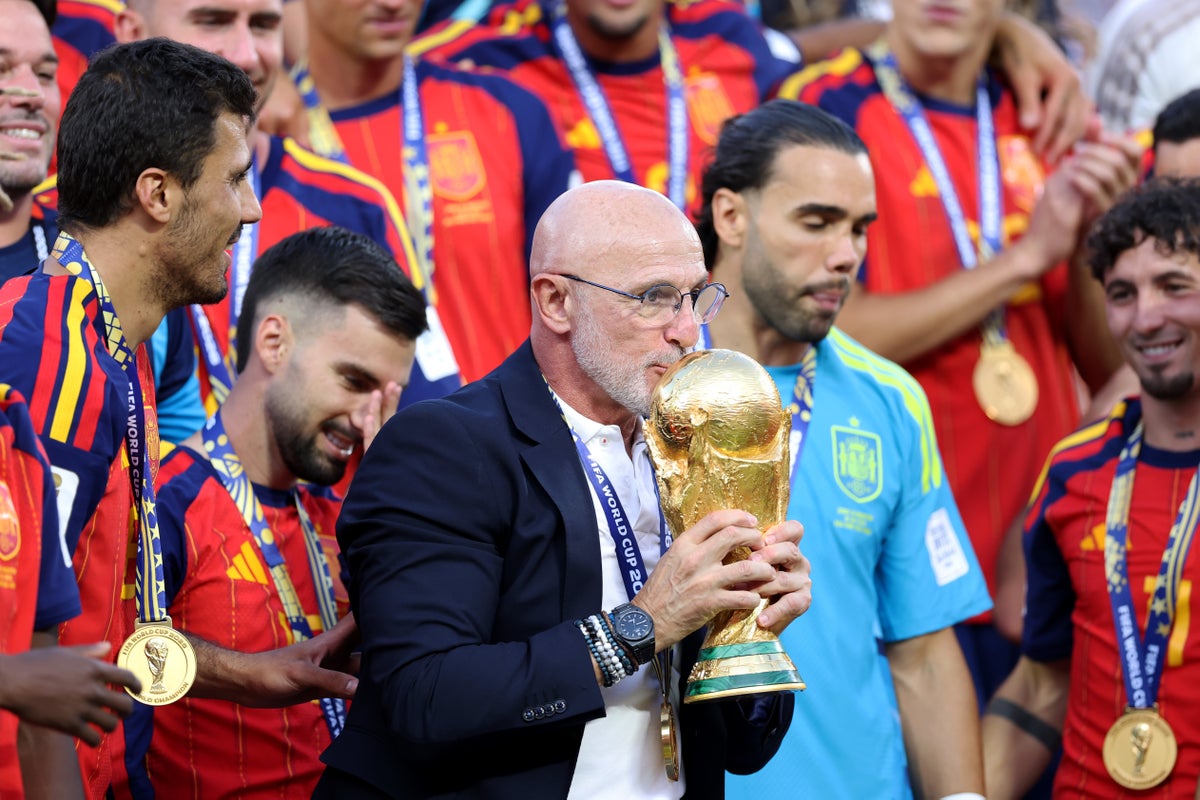
Spain Clinches Second World Cup Title with Victory Over Argentina
As the final whistle blew in New Jersey, Spain secured a World Cup triumph that briefly felt so inevitable, despite being almost two decades in the making.
Sixteen years after winning their first World Cup, La Roja earned a second star above their crest thanks to an outstanding performance from Luis de la Fuente’s team in the 1-0 win over Argentina.
De la Fuente saw his side play a near-perfect game as they beat Argentina in the World Cup final (Getty)
The scoreline flattered the Albiceleste, as Spain dominated possession but did not create as many chances as they could have. Argentina struggled throughout the match, with even Lionel Messi unable to save the team from a lackluster performance that favored Spain.
Argentina struggled to maintain possession, while Spain continued to assert control over the game. The Argentine defense remained firm during regular time; however, it was their attack that proved almost nonexistent, making them the first team to have no shots in a World Cup final after 90 minutes.
Ultimately, a needless red card for Enzo Fernandez sealed Argentina’s fate, allowing Spain to capitalize. Key players such as Rodri, Pedri, and Nico Williams were particularly impressive. Williams assisted Ferran Torres, whose half-volley secured the winning goal in extra time.
Spain’s win reflects their deserving performance, while Argentina’s ineffective strategy earned them little reward. Beyond Argentina’s struggles, Spain delivered an authoritative display that crowned them as one of the best teams in the world.
Spain’s successful Euro 2024 campaign mirrored their World Cup journey, with La Roja building momentum throughout the tournament. Their standout semifinal performance against France solidified their status as favorites, showcasing a highly talented squad and a clear footballing strategy from the skilled manager.

Spain’s win gives them their second World Cup trophy in their history (Reuters)

Spain were dominant from the early stages as they completely nullified any Argentina threat (Reuters)
This renewed football identity reflects De la Fuente’s adaptation of traditional tactics. Although Tiki-taka has evolved, Spain’s ability to retain possession remains key, demonstrated throughout the 120 minutes of the final. The combination of defenders Aymeric Laporte and Pau Cubarsi plays a crucial role in building attacks from the back while the full-backs support offensively.
The strategy was evident when Porro scored the second goal against France. In the final, both Porro and Cucurella displayed versatility by operating in various positions, culminating in Torres’ goal originating from a well-timed cross by Porro.
While Lamine Yamal served as a focal point on the wing, his impact was limited in this match. Nonetheless, his potential for decisive moments aligns with De la Fuente’s philosophy of creating overloads to gain advantage, which eventually led to the winning goal.

Nico Williams helped change the game and was unlucky to see a goal disallowed for a foul in the build-up (Reuters)
Following struggles on the opposite wing, De la Fuente introduced Nico Williams to further enhance their offensive strategy. Williams was instrumental in changing the game’s momentum and was involved in a disallowed goal before providing the assist for the winning effort.
This attacking display highlighted Spain’s ability to threaten opponents through possession and well-structured positional attacks. Nevertheless, the match was also notable for Spain’s strong defensive performance, essential to their success.
Spain’s strategy focused on regaining possession swiftly, with Rodri playing a central role in disrupting Argentina’s midfield and asserting control over the game.
With support from teammates, Spain executed coordinated counter-pressing, effectively denying Argentina opportunities to attack. As a result, Messi and the other Argentine forwards struggled to make a mark on the match.
Despite some frustration from De la Fuente regarding missed opportunities, Argentina’s lack of response felt like an inevitable defeat, especially after Fernandez’s red card. Torres ultimately sealed the win with a crucial goal.
Spain’s near-flawless display culminated in their second World Cup title, reaffirming their storied footballing tradition on both European and global stages, reminiscent of their dominance from 2008 to 2012. Many teams have attempted to mimic that era, and now, under De la Fuente’s guidance, Spain has returned to prominence.