
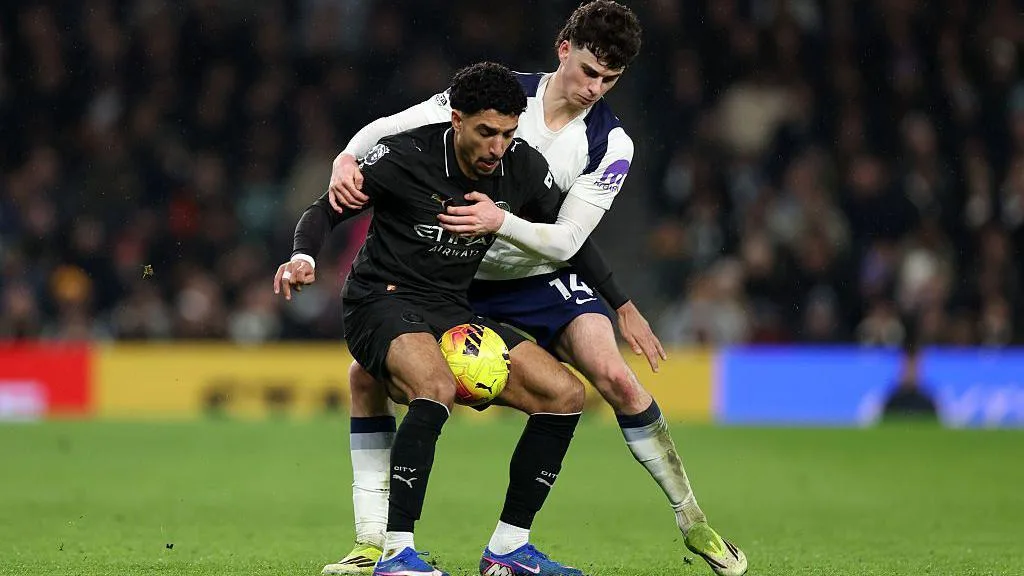
Omar Marmoush’s Versatility Can Benefit Brighton, Says Former Player
Omar Marmoush, who primarily occupies the number nine position, has showcased significant flexibility throughout his career. While playing for Frankfurt, he frequently took up central roles but has also thrived as a second striker and on the left flank. Similarly, at Manchester City, he has mainly functioned as a central attacker, while being utilized from the wings and just behind another forward.
This adaptability may align well with Brighton manager Roberto de Zerbi’s tactical approach. De Zerbi’s teams often feature forwards who shift positions, drop back to receive the ball, and exploit the spaces created as defenders shift out of position. Marmoush is adept at executing both tasks.
Former Manchester City defender Nedum Onuoha pointed out that Marmoush is particularly effective when he can challenge the space behind opposing defenses. “As much as he is good dropping towards the ball, I think he is better when he plays on the shoulder,” Onuoha stated. “He needs to be in a team that will constantly play balls in behind and force the opposition to run back towards their own goal. That’s when you see a better version of Marmoush.”
According to Opta’s Premier League statistics from the previous season, Marmoush averaged 11.46 runs behind defensive lines per 90 minutes, closely matching Dominic Solanke’s 11.61 and outpacing Richarlison’s 10.03. Moreover, Marmoush demonstrated superior creativity when in possession of the ball.
Omar Marmoush is primarily a number nine, but he has rarely been confined to one role across the front line.
At Frankfurt, he was used predominantly through the middle but also appeared as a second striker and from the left. Manchester City have followed a similar pattern, using him mainly as a central attacker while also deploying him from the flank and just behind another forward.
Advertisement
That flexibility could suit Roberto de Zerbi. His teams have often relied on forwards changing positions, dropping towards the ball and then attacking the space created when opponents are drawn out. Marmoush is comfortable doing both.
Former Manchester City defender Nedum Onuoha sees the Egyptian as most dangerous when he is able to threaten the space beyond the defence.
“As much as he is good dropping towards the ball, I think he is better when he plays on the shoulder,” he said.
“He needs to be in a team that will constantly play balls in behind and force the opposition to run back towards their own goal. That’s when you see a better version of Marmoush.”
Advertisement
Opta’s Premier League numbers from last season show he averaged 11.46 runs in behind per 90 minutes, almost identical to Dominic Solanke’s 11.61 and ahead of Richarlison’s 10.03. But he also offered considerably more with the ball.
[/gpt3]