
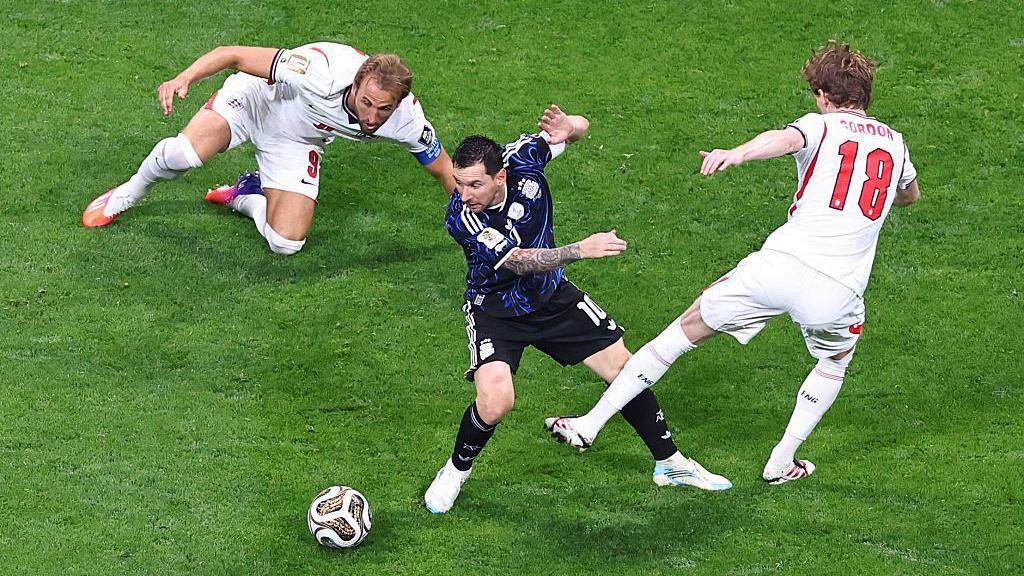
Argentina’s Lionel Messi Shines as England Falls Short in World Cup Semi-Final
England prides itself on physical play, which seemed suitable for facing a 39-year-old veteran who spends much of his time walking. However, the match did not unfold as expected.
Lionel Messi may not possess the same athleticism he once did, but his footballing intelligence compensates for this decline. As England began to lose control of the World Cup semi-final—partly due to their fatigue and Thomas Tuchel’s tactical adjustments—Messi took command, effectively acting as Argentina’s on-field strategist.
How did Messi identify and exploit England’s vulnerabilities to lead Argentina to victory in Atlanta?
How Argentina Gained a Foothold After England’s Start
In the first half, England sought to pressure Argentina high up the pitch. Wingers Anthony Gordon and Morgan Rogers pressured Argentina’s two central defenders, limiting options for goalkeeper Emiliano Martinez and center-backs Cristian Romero and Lisandro Martinez.
Argentina initially attempted simple passes through the middle, falling into England’s trap early in the match. Jude Bellingham, who was stationed deeper than anticipated, focused instead on keeping an eye on Enzo Fernandez, while Declan Rice marked Alexis Mac Allister, and Elliot Anderson found himself on Messi’s tail.
England aimed to physically challenge Argentina as the World Cup holders sought to establish their characteristic central-focused play. The England midfield trio initially stifled Argentina well, with Anderson particularly effective in limiting Messi’s influence.
However, Messi, along with Fernandez and Mac Allister, steadily grew into the game. Argentina’s captain began taking deeper positions, presenting Anderson with a dilemma about how closely to follow. Messi’s deceptive walking pace proved to be a strategic advantage.
From almost a standstill, Messi burst into action, forcing defenders to react to his sudden movements. As England’s intensity waned due to fatigue, Argentina began to gain control and move together as a cohesive unit.
How Messi’s Masterclass Undid England’s Hopes
England took the lead through Anthony Gordon in the 55th minute, holding on for about thirty minutes. However, Fernandez equalized in the 85th minute, assisted by Messi near the edge of the penalty area. Lautaro Martinez then scored the winning goal in stoppage time, heading in Messi’s cross.
During the time between Gordon’s goal and Argentina’s equalizer, England held only 12% possession, spending much of the second half defending deeply. This led to a contest of Argentina’s attack against England’s defense, which managed to hold firm, though only temporarily.
Argentina persisted, with Messi strategically exploiting cracks in England’s defensive structure and individual players’ weaknesses, sparking his team’s comeback. Initially effective against Messi, Anderson found his approach compromised as Messi adjusted to his playing style.
Messi began to use Anderson’s aggression to his advantage, holding onto the ball to draw the younger player out of position before cleverly passing to teammates in the now-vacated space.
For Argentina’s opening goal, Messi played a one-two following a short corner and upon receiving the ball again, he attracted defenders, allowing Fernandez to find space and strike decisively.
Recognizing Space and Creating Tension
England’s strategy focused on blocking central space to defend their lead and limit Argentina’s natural gameplay. Messi, however, moved to areas of space that emerged, either deep in front of England’s block or wide on the right touchline, capitalizing on his newfound freedom.
By positioning himself in these unmarked spaces, Messi either received the ball comfortably or drew defenders towards him, disrupting England’s shape and creating opportunities elsewhere.
Messi’s unconventional positioning empowered him to control the game with his remarkable dribbling and passing skills.
Taking Advantage of Bellingham’s Position
Though Bellingham excelled in attack throughout the tournament, his defensive positioning during this match allowed Messi to exploit weaknesses. In a standard 4-4-2 block, the near-side striker is typically responsible for aiding in defensive duties. Down Argentina’s right, this was Bellingham’s role.
Recognizing that Bellingham often ventured high up the pitch or was drawn to the ball, Messi capitalized on this by holding his position in the space behind him, allowing Argentina to sustain attacks and create dangerous situations.
How Argentina Undid Tuchel’s Tactical Tweaks
With Argentina committing numerous attackers into the box, Tuchel’s decision to shift to a back five aimed for numerical equality in the box. However, this setup inadvertently benefited Messi’s style of play.
With England’s back five pinned deep, their central midfielders struggled to cover the pitch’s width. Messi recognized this, rotating closer to goal while maintaining a deeper position on the right side.
As England transitioned to a 5-4-1 formation for better width coverage, Bellingham found himself in an unfamiliar holding midfield role. His natural instinct to drop toward his own goal led to difficulties in managing the distance when defending Argentina’s midfielders. A lack of pressure allowed Argentina to transition the ball effectively, with Messi ready to capitalize on openings.
Bellingham’s deep positioning gave Fernandez the room to shoot under little pressure, leading to the corner that resulted in Argentina’s equalizer.
By altering Fernandez and Mac Allister’s roles and introducing strong aerial players, Argentina began posing a significant threat to England’s goal during their most impressive period of attacking football in the tournament.