
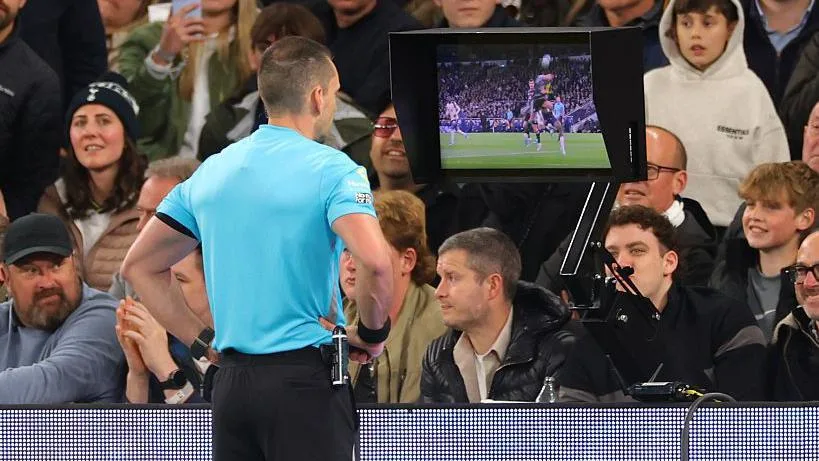
UEFA Referee Chief Addresses VAR Concerns, Launches New Fan Resource
Uefa referees’ chief Roberto Rosetti highlighted ongoing issues with the video assistant referee (VAR) system, stating that some reviews “were not connected with football” after his recent meeting with leaders from top European leagues.
Rosetti spoke while unveiling Clear Line, a pioneering portal aimed at helping fans understand when VAR should intervene. The initiative aims to create clarity around VAR processes in football.
During this gathering, refereeing officers from England, Spain, Germany, France, and Italy met with Rosetti and David Elleray, the Ifab’s technical director, to promote a consistent approach to officiating decisions.
“We realise that everywhere now there is not any satisfaction about how VAR is impacting football,” Rosetti remarked. He emphasized that avoiding “microscopic situations” is crucial, insisting that context matters. “It’s football, not PlayStation. We need to be very, very careful,” he added. “The referee must referee the match. It’s something important for football, for clear situations and clear mistakes.”
Rosetti acknowledged the challenge of harmonizing interpretations across leagues, particularly with handball rules. Last season, the Premier League maintained a more lenient standard, awarding a handball penalty every 17.27 games. This was followed by the German Bundesliga at 10.93, Spanish La Liga at 10.56, Italian Serie A at 10.00, and French Ligue 1 at 9.27. In the Champions League, penalties occurred every seven games, illustrating the complexity of reaching consensus among competitions.
On the Clear Line portal, UEFA has made available numerous video examples of handball situations to outline when a handball is considered an offence. “The idea is to be more consistent in the application of the laws,” Rosetti explained. Although he acknowledged the differing perceptions of handball in various leagues, he noted that the aim remains to work collaboratively for improvement.
Moreover, the VAR intervention rates in the Premier League and Champions League reveal stark contrasts. In the 2025-26 campaign, the Premier League recorded the lowest intervention rate in Europe at 0.29 per game, while the Champions League stood at 0.47 per game. Rosetti expressed concern about “too many reviews,” stating that this trend affects player behaviour, as they attempt to earn decisions through VAR.
“We wanted to come back to the origin of VAR,” Rosetti remarked, recalling incidents like Diego Maradona’s ‘Hand of God’ goal in 1986. “We are not happy any more about this kind of use of VAR. We want to try to come back a little bit, and to put again the referees at the centre.”
Rosetti also pointed out the growing issue of lengthy VAR reviews. He stated that checks exceeding 90 seconds risk “losing credibility.” A new collective protocol is now in place, which allows referees to examine a freeze-frame, followed by half-speed footage, and then full-speed for assessing the intensity of the challenge.
“We like referees with personality, taking decisions on the pitch, and VAR intervening only for clear and obvious situations,” the Italian official emphasized. He reiterated the need for clear visuals without excessive replays, saying, “It is something that for us is very important. Some on-field reviews were not connected with football. It’s about normal speed, context. It’s about football.”
Rosetti described Clear Line as “a guide for all the people of football” rather than just officials. The resource meticulously covers various areas of VAR oversight, including penalties, red cards, attacking offences, factual decisions, and mistaken identity, incorporating detailed video examples.
“We started to think about how we could help everyone to understand VAR better,” he shared. “This is a library, a structure, a document where we explain when and how VAR will intervene. This space is intended for clubs, players, and fans to consult after a Champions League match to compare incidents with the library.”
Uefa referees’ chief Roberto Rosetti says some video assistant referee reviews “were not connected with football” after meeting with leaders from the top European leagues last month.
Rosetti was speaking as he launched Clear Line, a first-of-its-kind portal for fans which tries to lay out when a VAR should, and should not, intervene.
Advertisement
The lead referee officers from England, Spain, Germany, France and Italy met with Rosetti and David Elleray, the Ifab’s technical director, to try to find a more uniform approach to decisions.
“We realise that everywhere now there is not any satisfaction about how VAR is impacting football,” Rosetti said.
“So we want to avoid microscopic situations. The context is super important. It’s football, not PlayStation. We need to be very, very careful.
“The referee must referee the match. It’s something important for football, for clear situations and clear mistakes.”
Advertisement
Too many reviews – Rosetti
Roberto Rosetti is a former referee who officiated the Euro 2008 final [Getty Images]
Rosetti conceded that trying to find a consistent approach across all leagues, which tend to have their own interpretations of some offences, would be difficult.
In particular, handball continues to cause issues across football.
The Premier League had the most relaxed interpretation of handball last season, with a handball penalty every 17.27 games.
Then came the German Bundesliga at 10.93 games per handball penalty, the Spanish La Liga on 10.56, the Italian Serie A on 10.00 and the French Ligue 1 at 9.27.
In the Champions League, it was a penalty every seven games – the highest frequency in Europe – which highlights the difficulty in reaching a consensus across competitions.
Advertisement
On Clear Line, Uefa has uploaded many video examples of handball situations to explain what is considered an offence.
“The idea is to be more consistent in the application of the laws,” Rosetti said
“The perception about handball in England is different. Football is not perfect, and sometimes we will continue to have similar situations interpreted in different ways. But at least we are working together.”
With VAR, too, the Champions League and the Premier League are worlds apart.
In the 2025-26 campaign, the Premier League had the lowest intervention rate in Europe at 0.29 per game, while the Champions League was 0.47 per game.
Advertisement
Rosetti said that there were “too many reviews” and more interventions were affecting player behaviour, with attempts to play for or earn video decisions.
“We wanted to come back to the origin of VAR,” Rosetti said, referencing incidents like Diego Maradona’s ‘Hand of God’ goal for Argentina against England at the 1986 World Cup.
“We are not happy any more about this kind of use of VAR.
“We want to try to come back a little bit, and to put again the referees at the centre.”
‘It’s about normal speed, context’
Rosetti said that the time being taken over VAR reviews was a particular concern, with lengthy reviews featuring multiple TV replays being less acceptable to supporters.
Advertisement
Any check longer than 90 seconds, Rosetti says, risks “losing credibility”.
A new collective protocol was agreed whereby, when at the monitor, a referee would be shown a freeze-frame for point of contact, followed by half-speed, and then full speed for the intensity of the challenge.
“We like referees with personality, taking decisions on the pitch, and VAR intervening only for clear and obvious situations,” the Italian said.
“So clear images without too many replays. It is something that for us is very important.
“We were seeing that some on-field reviews were not connected with football. It’s about normal speed, context. It’s about football.”
Advertisement
Rosetti described Clear Line as “a guide for all the people of football” and not for officials.
It goes through each area the VAR covers – penalties, red card, attacking offences, factual decisions and mistaken identity – in great detail with video examples.
“We started to think how we could help everyone to understand VAR better,” he said.
“It’s a library, a structure, a document where we explain when [and] how VAR will intervene.
“This is not a web page for referees. This is the space that we would you to go to after a Champions League match to check how an incident compares with this library.
Advertisement
“It’s for the clubs, for the players, for the fans.”
[/gpt3]