
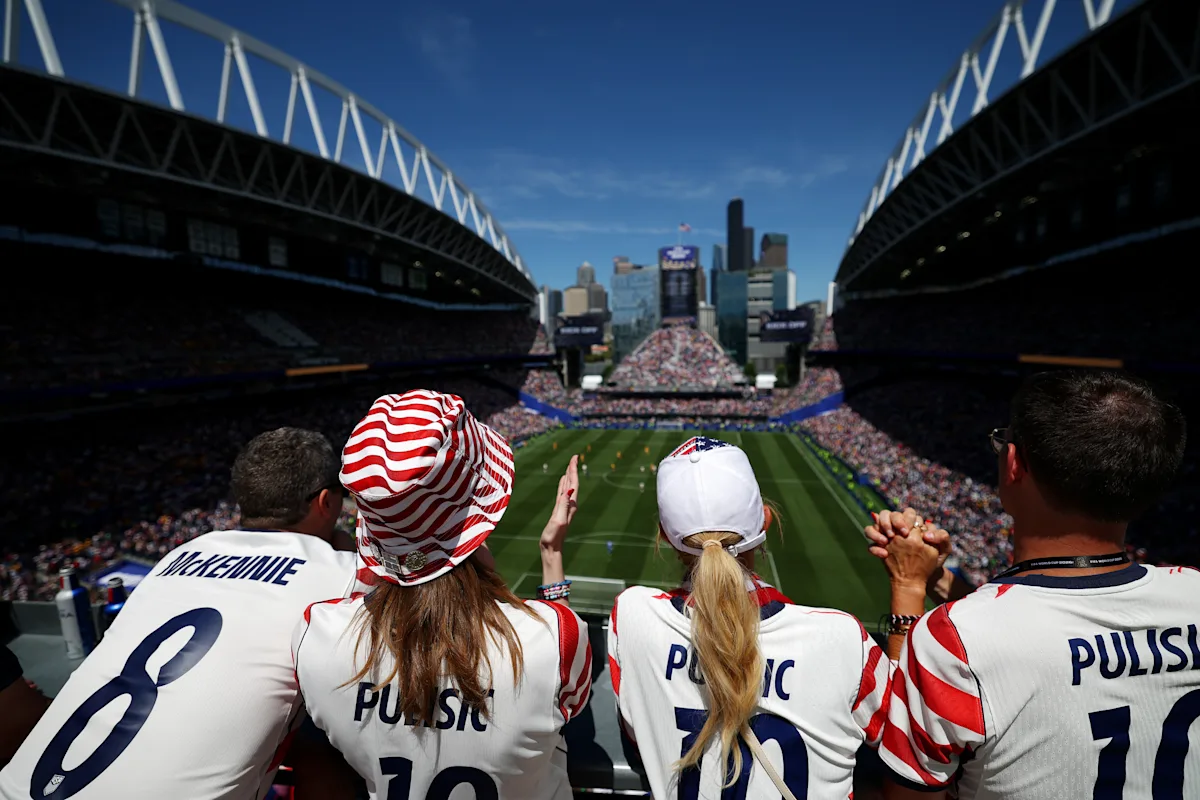
Fans Embrace High Ticket Prices to Experience World Cup History in Seattle
Two days prior to the United States men’s national team (USMNT) match against Australia in Seattle, Jakub Heyduk, Andy Skosky, and Jim Martin invested $1,800 each in tickets to the event.
“We entered over 10 different raffles and things like that and never got selected. We were just waiting and eyeing the right time to buy, and pulled the trigger on Wednesday,” Heyduk shared with Yahoo Sports ahead of the June 19 matchup, which the USMNT won 2-0.
Advertisement
Gathered in the Seattle Stadium concourse, the friends, enjoying beers at 9:30 a.m., acknowledged the steep ticket prices. (The get-in price had dropped slightly to $1,500 just before the game.) The stars aligned for the trio: Heyduk and Skosky are based in Seattle, while Martin was visiting from St. Louis, coinciding with the U.S. game.
“We’re in our 40s,” Martin remarked.
“On the decline,” Heyduk joked.
“Right, on the decline,” Martin reiterated. “Is it going to be easy for us to go to a World Cup again in the future?”
“And will it ever be in our home, like driving to the light rail and just riding down here, having a place to stay? My wife and I have talked a lot about it because we said, ‘we’ll go to a World Cup at some point,’” Skosky added. “But then it was just a matter of being here and I thought, gosh, this is a big game. I think I would regret it if we didn’t get to go.”
Advertisement
Time and again, fans echoed the sentiment regarding the opportunity to witness the World Cup on U.S. soil: “once-in-a-lifetime.”
“I saw the tickets; they were insane,” Juan Olmeda, who drove up from central Oregon, said ahead of the match against Australia. “But we gotta go.”
“World Cup in your stadium, home city, it might not happen again until I’m 70,” Seattle resident Michael Pruitt told Yahoo Sports before the USMNT’s Round of 16 game against Belgium on July 6. “It’s either now or never.”
Fans of the United States show their support during the FIFA World Cup 2026 Group D match between USA and Australia at Seattle Stadium on June 19, 2026 in Seattle, Washington.
(Steph Chambers – FIFA via Getty Images)
As the 2026 World Cup approached, ticket prices were a significant concern. FIFA’s dynamic pricing model resulted in exceptionally high ticket costs, making this edition the most expensive to date.
Advertisement
The steepest prices were for USMNT matches, driven by fan demand. FIFA aimed to enhance the overall experience, banking that fans would be willing to pay more — and largely, they were correct.
Interviews with fans, both inside and outside the stadium, showed they were more than willing to make sacrifices to support their team on home soil: spending thousands, flying across the country, and adhering to FIFA’s extensive restrictions, which some criticized as excessive.
‘Might as well see our team’
In the months leading up to the tournament, ticket prices soared to thousands of dollars for nosebleed seats, causing speculation about who would actually attend. Critics warned of empty seats, particularly in group stage matches featuring teams from smaller nations, as part of FIFA’s expanded 48-team format criticized as a cash grab.
Advertisement
However, the expansion proved successful and enjoyable, with stadiums hitting approximately 99.7% occupancy during the Round of 16, according to FIFA estimates.
FIFA’s strategy hinged on fans flocking to popular U.S. cities and large NFL stadiums. Many USMNT supporters traveled long distances to witness their team play.
At the two matches in Seattle, fans shared stories of flying in for short visits or driving early in the morning from out of state. Many chose this route due to the absence of nearby host cities. Still, the desire to see their team play in the World Cup drove their decisions.
Before the match against Australia, the Line family — Justin, Krista, and their youngest son Mike — flew in from Ohio. They initially considered staying closer to home, but decided to attend the U.S. game.
Advertisement
“Might as well see our team, versus go to another city and see another team,” Justin said. “If we’re gonna spend thousands of dollars to go see someone else play, we might as well enjoy it.”

United States fans march together to the Seattle Stadium before the FIFA World Cup 2026 Group D match between USA and Australia on June 19, 2026 in Seattle, Washington.
(Jane Gershovich/ISI Photos via Getty Images)
For the match against Belgium, Ashleigh and Steve Behnke traveled from Kentucky with their four sons. They recognized the high cost but appreciated the opportunity. Without World Cup games nearby, they had been eager to secure tickets for a U.S. match.
Initially considering a July 4 game in Philadelphia, they ultimately chose to see the USMNT in the Round of 16, despite buying tickets before the U.S. officially defeated Bosnia and Herzegovina for advancement: “We were really holding our breath,” Ashleigh confessed.
Advertisement
Ashleigh estimated they spent around $30,000 on hospitality tickets, which included additional perks, without clarifying whether travel and accommodations were part of that total. They viewed the trip as a family milestone, celebrating achievements with the experience of watching the U.S. compete in a significant match.
“This is like a trip to Europe, and to have it, and really to be able to share it with our boys,” Ashleigh said. “To have the shared experience, you just can’t trade that.”
The chance to witness history
FIFA has long understood that every game in the World Cup transcends mere sport. Experiencing the tournament in person is a coveted and cherished opportunity, drawing fans from around the globe. In conversations with Yahoo Sports, Alexandria Drake and Amber Gopher spoke about the deeper significance of the World Cup. The two Seattle locals connected while waiting for the USMNT match against Belgium.
Drake, who attended two matches in Seattle and traveled to Vancouver for another, treasured the moments spent meeting fellow fans. She interacted with individuals from all over the world, including locals like Gopher.
“I feel like this summer has lifted; there’s a lightness that I feel, it was needed. Things were looking pretty grim,” she shared.
That uplifting spirit contrasts with a larger discussion about the World Cup’s commercialization under FIFA’s umbrella.

A United States fan during the second half of a World Cup round of 16 knockout match between United States and Belgium at Lumen Field on Monday, July 6, 2026 in Seattle, WA.
(Allen J. Schaben via Getty Images)
For those attending the games in person, the investment proved worthwhile for the broader experience. Especially for USMNT supporters, it represented a pivotal moment in developing soccer enthusiasm in the U.S.
Advertisement
Both Drake and Gopher attended the U.S.-Belgium match solo, as neither of their partners wanted to shoulder the high costs. Drake spent $600 on a ticket just a day before the match, which she noted was “a flukey thing.” Gopher paid $3,000 for hers after the U.S. advanced to the Round of 16. Regardless of the price difference, both were equally thrilled about the day’s potential.
“I knew they were going to come here and thought, ‘Oh man, I would love to be there because it’s history.’ I just wanted to be there and witness it because I don’t think I’ll ever do this again,” Gopher said. “I dipped into the savings for this one, but it’s worth it.”
“I’m hoping this is the start of a new era,” Drake said regarding the USMNT. “Just super cool to be here.”
Despite the excitement, the USMNT faced early exit from the tournament, bowing out in the Round of 16 alongside its co-hosts, Canada and Mexico. Subsequently, FIFA saw ticket prices for remaining knockout matches drop.
Advertisement
This price decrease was short-lived; ultimately, the World Cup final emerged as one of the most costly sporting events ever, with get-in prices reaching $7,444 and tickets soaring to $39,704 before kickoff. Nevertheless, many fans found the expense worthwhile for witnessing the final, as Spain triumphed over Argentina.
This illustrates the dedication of fans like Dana Garner and Craig Campbell, Seattle locals who attended the USMNT’s group stage match, and were determined to experience the World Cup in their hometown.
“We were always coming,” Garner stated. “It’s just one of those things you’ve gotta do.”