
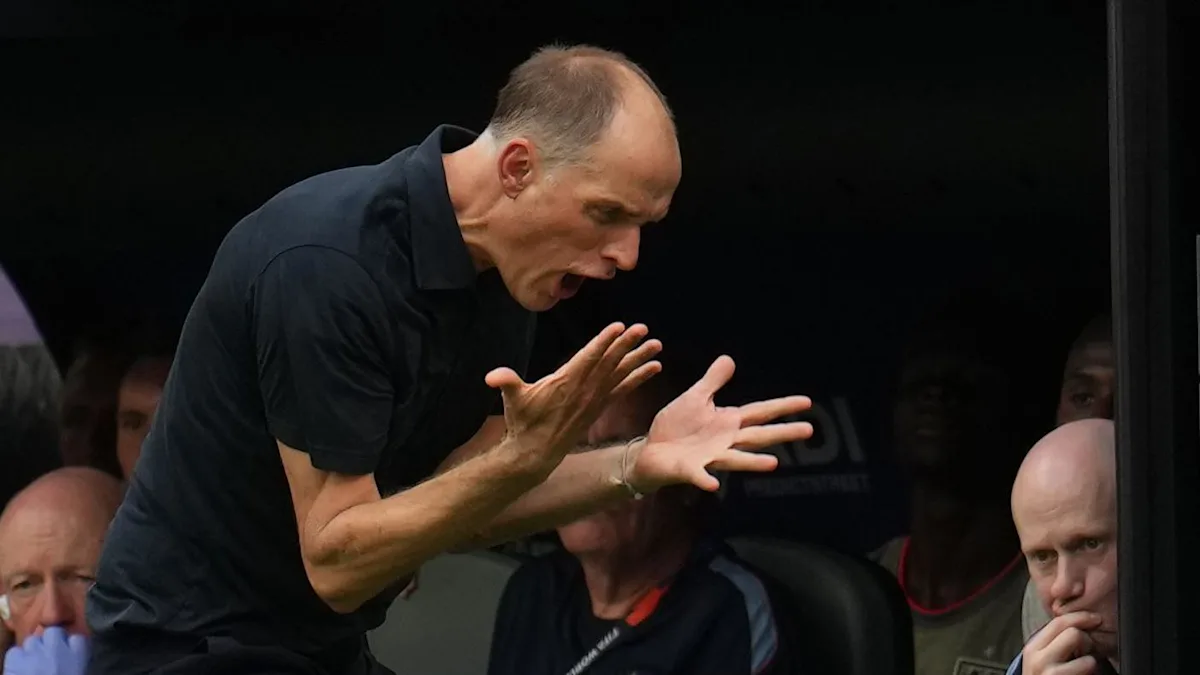
Thomas Tuchel demands improvement despite England’s World Cup win over Norway
England secured a hard-fought victory against Norway in Saturday’s World Cup quarter-final, but manager Thomas Tuchel voiced clear concerns regarding the display.
“We made life very difficult for ourselves,” Tuchel said. “The result is fantastic but I’m not happy with the performance.”
He commended the players for their heart, adding, “I’m impressed with the effort, team spirit and belief to overcome adversity. But I am also a football coach and I think we can play better. We had a lot of momentum swings for both teams. We made life difficult in the way we played, sloppy, a lot of technical mistakes, not fast enough, not repetitive enough.”
How does Tuchel want England to play?
When selecting his World Cup squad, Tuchel prioritized a specific tactical style. Players earned their spots based on their ability to perform in predefined roles—notably Jude Bellingham and Morgan Rogers competing for the number 10 position.
These roles rely on several key principles:
-
Play deliberate passes to entice opposition pressure
-
After enticing pressure, accelerate play, looking to find forwards in space
-
Against defensive blocks, attack down the flanks, using wide triangles and rotations to create chances
While England has shown these traits in glimpses throughout the tournament, Tuchel remains unsatisfied.
What did Tuchel want to see against Norway?
Tuchel’s post-match critique focused on ball retention and attacking structure. Stale Solbakken’s Norway utilized a 4-5-1 defensive block, while England attacked in a 3-2-5 shape.
The back line featured Marc Guehi, John Stones, and Ezri Konsa, while Declan Rice and Elliot Anderson operated in midfield. Left-back Nico O’Reilly pushed forward to support the attack, providing an extra body against the Norwegian defense.
Tuchel’s complaint that the side was “not repetitive enough” likely referred to a lack of sustained, short-passing sequences intended to draw the opposition out. By forcing the opponent to shift, England can open space for wide attackers or long balls. In the group stage match against Ghana, Tuchel instructed his players to move the ball “short, short, short” before executing a “long switch,” a tactic England displayed during the first quarter against Norway.
However, as the game progressed, this tactical baiting diminished. England struggled to maintain possession, with their share of the ball dropping from 68% in the first half to 44% in the second.
The untapped potential of England’s wide triangles
Positional rotations in wide areas were intended to be a cornerstone of England’s attacking strategy. Norway’s 4-5-1 set-up offered perfect conditions for these maneuvers, but Tuchel felt his team lacked the necessary speed.
Norway’s wide midfielders held their positions rather than dropping into the back line, leaving potential gaps. For example, when Anthony Gordon moved inside from the left wing, space opened for Anderson or O’Reilly to exploit behind the opposition full-back. Because Norway defended zonally, they often failed to track these off-the-ball movements.
‘Fearful’ and ‘sloppy’
Tuchel described England’s play as “sloppy” when they failed to capitalize on these patterns. Instead of playing quickly into wide areas, defenders often held the ball or attempted forced passes through the middle, leading to turnovers.
Assistant coach Anthony Barry noted similar issues earlier in the tournament, stating after the opening win against Croatia that the team fell into “fearful patterns” by failing to play through the gaps or accelerate their game.
How do England keep winning?
Despite these tactical struggles, England advanced. The team consistently exploits moments of defensive disorganization.
For the opening goal, Anderson took advantage of Norway shifting to defend a long goal-kick. His direct run drew the Norwegian right-back out of position, allowing Gordon to advance unmarked and eventually setting up Bellingham. A similar pattern occurred for the winning goal, where England pounced on a transition following a corner. Morgan Rogers fired a powerful shot from distance, and Bellingham reacted quickly to convert the rebound.
Bellingham noted the mental side of the game, saying, “The game is split into loads of different facets – technical, tactical, and, the biggest one is psychological, managing adversity.”
While the players continue to display individual quality and resilience in chaotic moments, Tuchel maintains that “performance helps you win games.” As England prepares for a semi-final against Argentina—a team with known defensive vulnerabilities on the flanks—Tuchel remains focused on perfecting his wide triangles.