
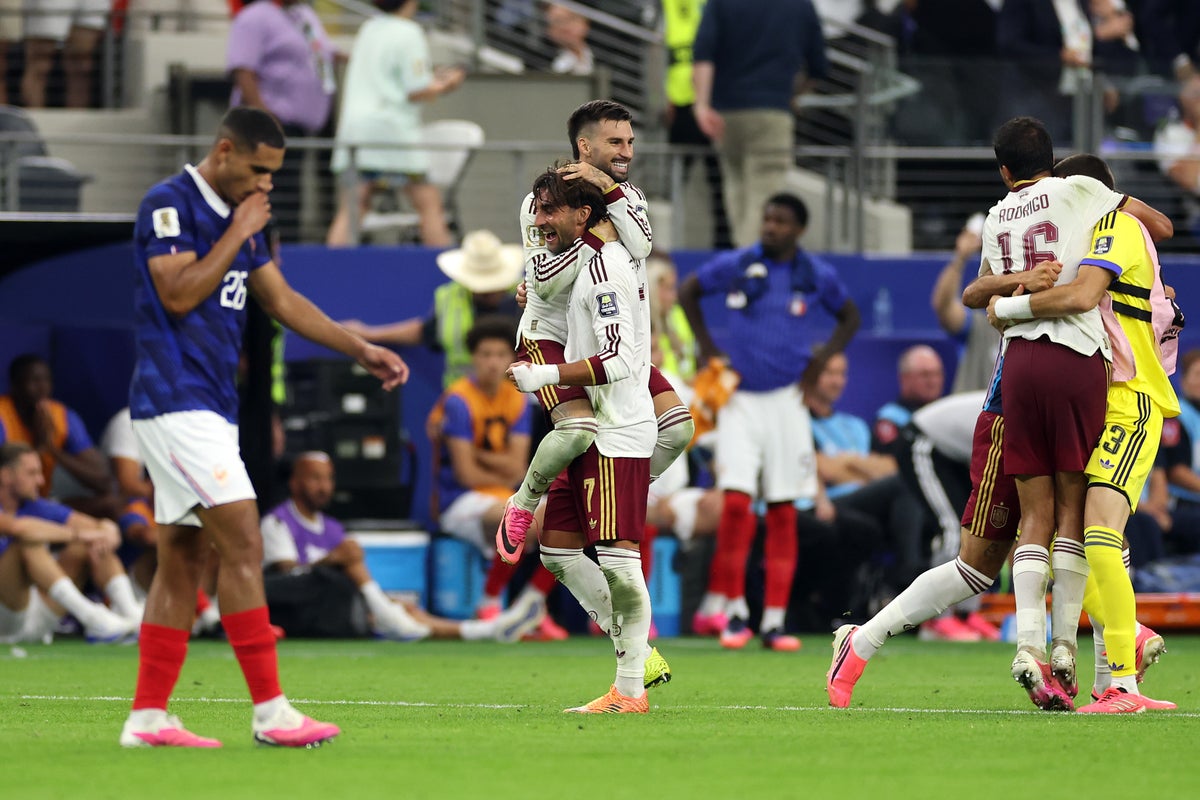
Spain Triumphs Over France, Earning Spot in World Cup Final
Spain players stepped out onto the Dallas pitch on Tuesday, driven by more than just the prospect of a World Cup final. They aimed to secure their place in a way that reflected the ongoing debate, as much as it was about reaching the semi-final.
Spain was well aware of the excitement surrounding France’s attacking style, often dismissing the European champions as a lesser side. They did not only intend to prove their superiority but also to showcase a more refined approach to the game.
What stood out in Spain’s 2-0 victory was how they established dominance confidently. Despite fears surrounding the exuberant French attack, Luis de la Fuente’s team took the ball in tight spaces and displayed remarkable bravery. Each forward pass conveyed a message, viewed in Spain as a return to form for la seleccion.
Spain celebrate an impressive semi-final win over France (Getty)
The standout goal, featuring Pedro Porro’s remarkable one-two finish, mirrored the very move that initially marked Spain’s rising dominance. Back in October 2007, during a Euro 2008 qualifier against Denmark, Luis Aragones’ side experienced a resurgence, culminating in a stunning 28-pass play that led to a goal.
The Porro goal has since been viewed as a reaffirmation of that enduring football philosophy, enhanced for modern times.

Pedro Porro’s goal was the culmination of the footballing idea at Spain’s very core (Reuters)
The overall performance echoed the Euro 2012 final, and Spain’s determination to make a statement was evident. Porro’s celebration underscored a collective ethos; they were not merely showcasing a Spanish style, but igniting a broader discussion surrounding it.
Spain’s possession game has faced criticism over the years, particularly contrasted against France’s dynamic approach, intensifying their performance.
While criticism of Spain’s style is prevalent, one must consider the complexities behind it. At times, the assessments seemed harsh, particularly during eras when opposition teams struggled against Spain’s strategy.

Is Spain’s impeccable ball retention and passing actually boring? (Getty)
Spain’s earlier Euro 2008 winners were similarly critiqued alongside France, as opponents were often unprepared. By 2010, however, the dynamics changed dramatically, influenced by a shift in tactical approaches during the era.
This led to increased defensive responses against Spain’s style, resulting in high-stakes challenges. Vicente del Bosque then adjusted tactics, gravitating towards a more balanced formation. However, this adaptation brought about its own challenges.

After a trophy-laden spell from 2008 to 2012, Spain became stale (Getty)
From 2014 onward, Spain struggled with their identity, adhering too strictly to their possession style, leading to elimination by Russia in 2018, highlighting the need for evolution.
Luis Enrique began this transformation, with De la Fuente’s continuity in the national system since 2013 fostering further development of established ideas.

Luis de la Fuente took the ideas to the next level as Spain coach (Reuters)
Notably, De la Fuente’s familiarity with many of the current players, having worked with them through youth teams, adds depth to Spain’s playstyle. This was especially crucial following the challenges faced earlier in the World Cup.
Despite earlier struggles, De la Fuente returned to core principles, significantly enhancing their execution. Rodri epitomized this strategy, forcing opponents to retreat.
Spain’s approach has proven effective against weaker responses, showcasing technical excellence rather than predictability. As demonstrated against France, Spain’s ability to play through their opponents remains intact.
Emerging from the under-19 Euros triumph, Spain is poised to maintain their talent and coaching evolution.
A potential twist in the upcoming final is Argentina’s capacity to counter Spain’s style, as Lionel Scaloni revitalizes the Argentine approach favoring short passes. The outcome will hinge on whether Argentina will engage Spain on similar terms, or opt for a defensive battle.
With both strength and vulnerabilities at play, Spain’s assertiveness will be essential, underscoring the importance of form as they approach the World Cup final.