
England looks to maintain quarter-final momentum under Thomas Tuchel
During Euro 2016, England anticipated a quarter-final clash against France in Paris. That match never happened. The last-16 tie against Iceland became one of the most humbling moments in the national team’s history.
It served as a major turning point. Roy Hodgson resigned, following criticism for his decision to skip scouting Iceland in person, opting instead for a boat trip on the Seine with his assistant, Ray Lewington. Since then, England has maintained a perfect record in this stage. When Thomas Tuchel leads his squad to Miami, he will be aiming for a fifth successive quarter-final appearance. No other nation has reached the final eight in each of the last three World Cups and two European Championships.
Gareth Southgate deserves significant credit for this consistent performance; his four quarter-final appearances mark a notable achievement. England developed into a team that expects to advance deep into tournaments. This change in mentality mirrors a trend of stronger group stage starts: including Tuchel’s World Cup, England has topped its group in the last four tournaments, suffering only one defeat in 15 pool matches. Winning the group typically provides a clearer path to the quarter-finals; the only time England failed to do so, in 2018, the outcome provided a more favorable route to the semi-finals because defending champions Germany were eliminated in the first round.
Throughout their history, England has functioned as different types of quarter-final teams. Over the past decade, they have proven they can win these matches: beating Norway would mark their fourth victory in five attempts. Previously, this round often acted as a barrier. When Southgate’s team defeated Sweden in 2018, it secured England’s first quarter-final win in 22 years, their first on foreign soil in 28 years, and their first within 90 minutes since 1966.
Gareth Southgate embraces Bukayo Saka after England beat Switzerland in the Euro 2024 quarter-finals (Getty)
This represented a departure from the past, especially considering that after Sven-Goran Eriksson’s three consecutive quarter-finals, England reached only one more until 2018. The last decade suggests that, despite not winning a major trophy, England navigates the knockout stages and entire competitions more effectively. This explains why players like Harry Kane, Jude Bellingham, Declan Rice, John Stones, and Jordan Pickford hold such impressive records in tournament business ends.
However, it is also notable who their quarter-final opponents have been. Under Southgate, they defeated Sweden, Ukraine, and Switzerland; none of these were established superpowers. Tuchel now faces Norway, a team that conquered Italy in qualifying and Brazil in the last 16. Norway possesses one of the world’s finest strikers in Erling Haaland and ranks among the top 10 international teams today, even if they have never reached this stage before. Success often proves self-perpetuating, as the countries that win quarter-finals are frequently those that have done so in the past.
Consider England’s history. In 1990, they beat Cameroon in the African nation’s first quarter-final experience, and in 1996, they defeated Spain on penalties at Wembley.

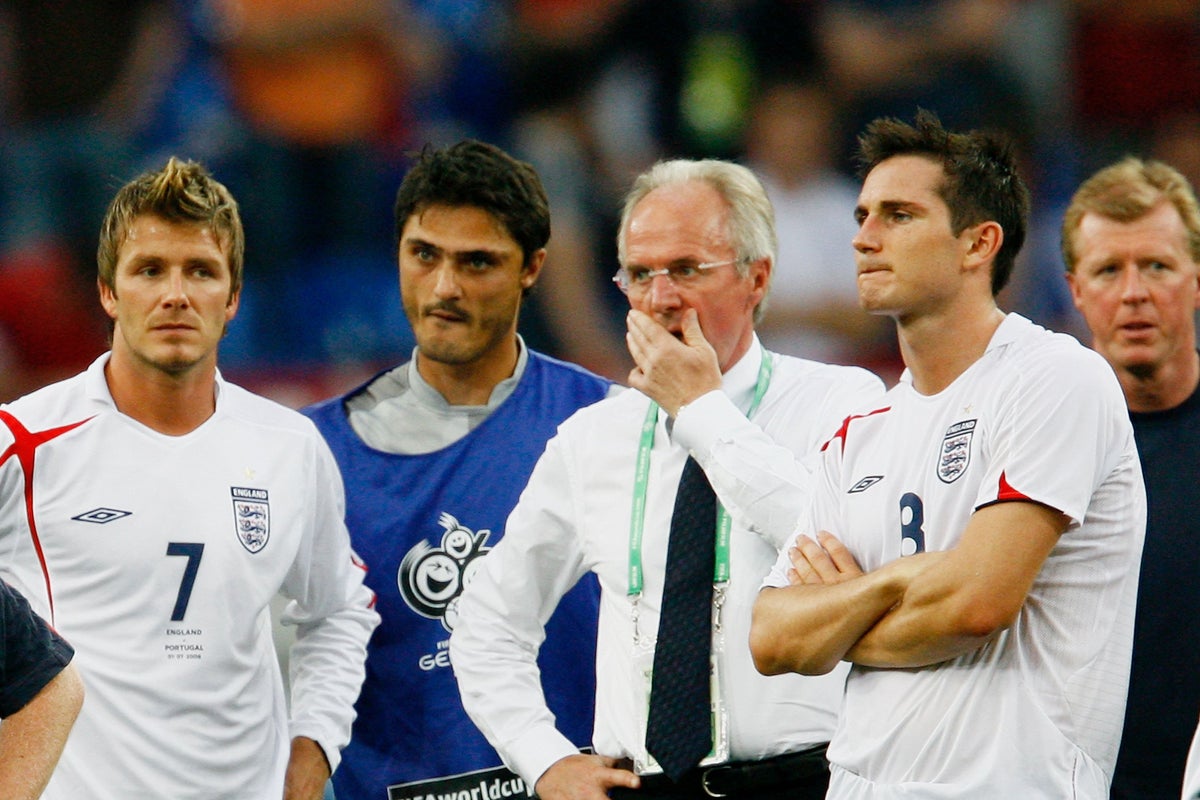
England suffered heartache in defeat by Portugal at the 2006 Wolrd Cup (Getty Images)
England’s quarter-final defeats have occurred against major powers: West Germany in 1970, Argentina in 1986, Brazil in 2002, Italy in 2012, and France in 2022. Portugal, who eliminated England in 2004 and 2006, might not qualify as a traditional superpower, though they featured a golden generation, a World Cup-winning coach in Luiz Felipe Scolari, and home advantage in the earlier meeting. In 1982, playing under a different format, England’s effective quarter-finals were against West Germany and hosts Spain.
Various managers, from Sir Alf Ramsey to Hodgson—including Ron Greenwood, Bobby Robson, and Eriksson—might have welcomed matches against Sweden, Ukraine, or Switzerland (though Eriksson struggled against his home nation). In each instance, however, England faced a team that had advanced further than analysts expected.
The same might apply to Norway now, especially since the draw placed them against Brazil in the last 16. However, with Erling Haaland, Norway possesses a match-winner that Sweden, Ukraine, and Switzerland arguably lacked.

England must find a way to stop Erling Haaland (Reuters)
Although England rarely entered quarter-finals as favorites over the past half-century—and while previous tournament exits were not strictly disastrous—there remains an art to winning winnable games.
England has consistently achieved this over the last decade. They have succeeded where they previously failed. In Mexico, unlike in Spain or Portugal, they won what amounted to an away match against the hosts. In Euro 2020, unlike many other tournaments since 1966, they defeated Germany, albeit in the last 16.
Quarter-finals no longer act as their kryptonite. After winning three across their history, they have won three in the last eight years. A fourth would signal a shift in identity, marking the transition from a team that occasionally reached quarter-finals to one that frequently wins them.