
England and Argentina Renew Historic Football Rivalry in World Cup Semifinal
It is a footballing rivalry that spans generations. England versus Argentina for a place in the World Cup final is a classic, iconic, and generational clash.
On Wednesday in Atlanta, Lionel Messi plays against England for the first time in his career. The defending world champions now aim to stop Thomas Tuchel’s Three Lions from ending 60 years of hurt. This World Cup rivalry began in 1962 and has featured wonder goals, controversy, and red cards ever since.
Beyond the pitch, political tensions—particularly surrounding the Falklands War in the 1980s—dominate the relationship between the two nations. Argentina players and fans still reference the conflict in football songs. While England holds a superior record in their five World Cup meetings, they have not won a match against Argentina that carried significant stakes for some time. With their last World Cup encounter occurring in 2002, many younger fans may not recall the history of this intense rivalry.
1962: England 3-1 Argentina (Rancagua, Chile – group stage)
This opening encounter proved a tame affair compared to future meetings. Goals from Ron Flowers, Bobby Charlton, and Jimmy Greaves secured a 3-0 lead for England, with Argentina scoring a late consolation. Both sides finished the group stage with one win, one defeat, and one draw, but England advanced on goal difference before losing to Brazil in the quarter-finals.
1966: England 1-0 Argentina (Wembley, England – quarter-finals)
This match arguably solidified the rivalry. Argentina still insists they were robbed, claiming Geoff Hurst’s winning goal was offside. The controversy deepened when Argentine captain Antonio Rattin received a red card after 33 minutes for two offences committed in quick succession. He first tripped Bobby Charlton, then continued to argue with German referee Rudolf Kreitlein.
The match stopped for nearly eight minutes as Rattin refused to leave the field. In an incredibly ill-tempered game, England manager Alf Ramsey famously described the Argentine side as “animals” and forbade his players from swapping shirts. This match is believed to have prompted the introduction of red and yellow cards for the 1970 World Cup. Rattin, who played in both the 1962 and 1966 tournaments, died at the age of 89 on Saturday.
1986: Argentina 2-1 England (Mexico City, Mexico – quarter-final)
Four years after the Falklands War, political tensions reached a boiling point. The Argentine public viewed the match as a chance to express resentment, while British media used nationalistic language to heighten the animosity.
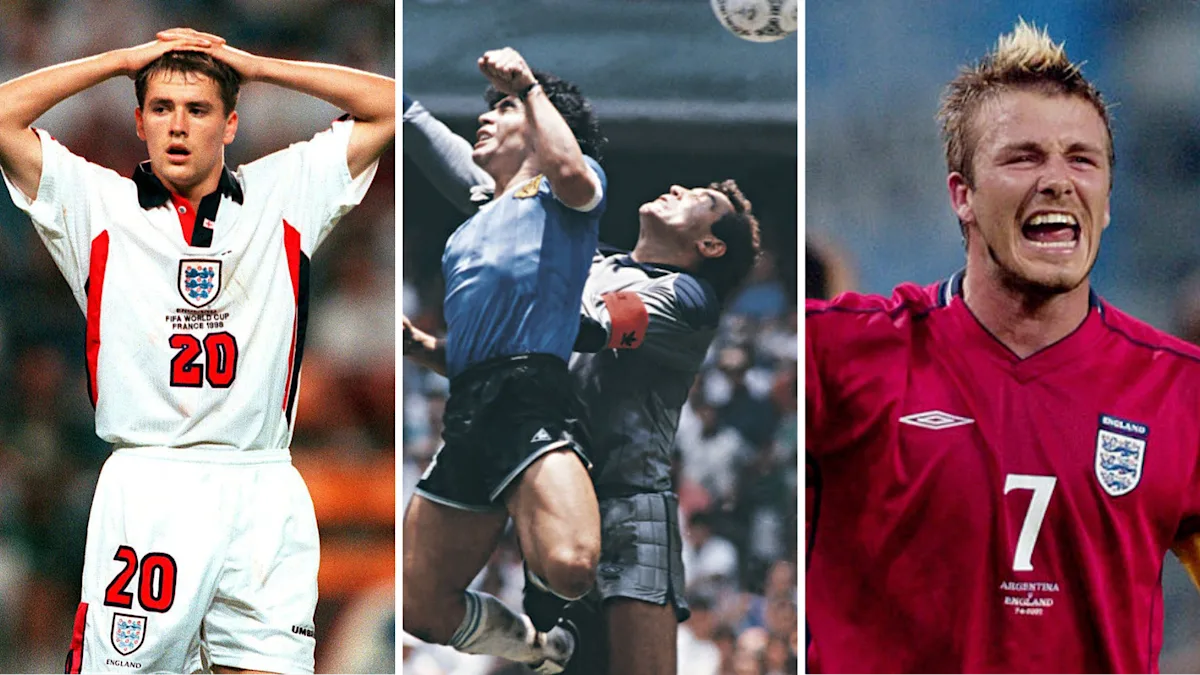
The match provided one of the most famous moments in history: Diego Maradona punched the ball past England goalkeeper Peter Shilton into the net. Later, Maradona scored what is widely considered the greatest World Cup goal of all time, dribbling through half the England team to double Argentina’s lead. Gary Lineker pulled one back for England, but they crashed out. Maradona did not apologize for the “Hand of God” goal until 2005, an apology Shilton rejected. Argentina went on to beat West Germany in the final.
1998: Argentina 2-2 England (Argentina win 4-3 on penalties) (St Etienne, France – last 16)
David Beckham will never forget this game. The match is remembered for his red card after he kicked out at Diego Simeone. Before the dismissal, Gabriel Batistuta and Alan Shearer traded penalties, and Michael Owen scored a spectacular solo goal to put England 2-1 ahead. Javier Zanetti leveled the score before halftime.
Despite playing with ten men, England held on, and Sol Campbell had a goal ruled out for a push in the 81st minute. Argentina ultimately prevailed in the penalty shootout. A year later, Simeone admitted: “The referee fell into the trap. You could say that my falling transformed a yellow card into a red card.”
2002: Argentina 0-1 England (Sapporo, Japan – group stage)
This match marked redemption for Beckham. The England captain scored the only goal of the game from the penalty spot after Mauricio Pochettino fouled Michael Owen. The win was crucial for the Three Lions, who went on to progress to the knockout stages, while Argentina were eliminated before the knockouts for the first time since 1962. England eventually exited in the quarter-finals against Brazil.