
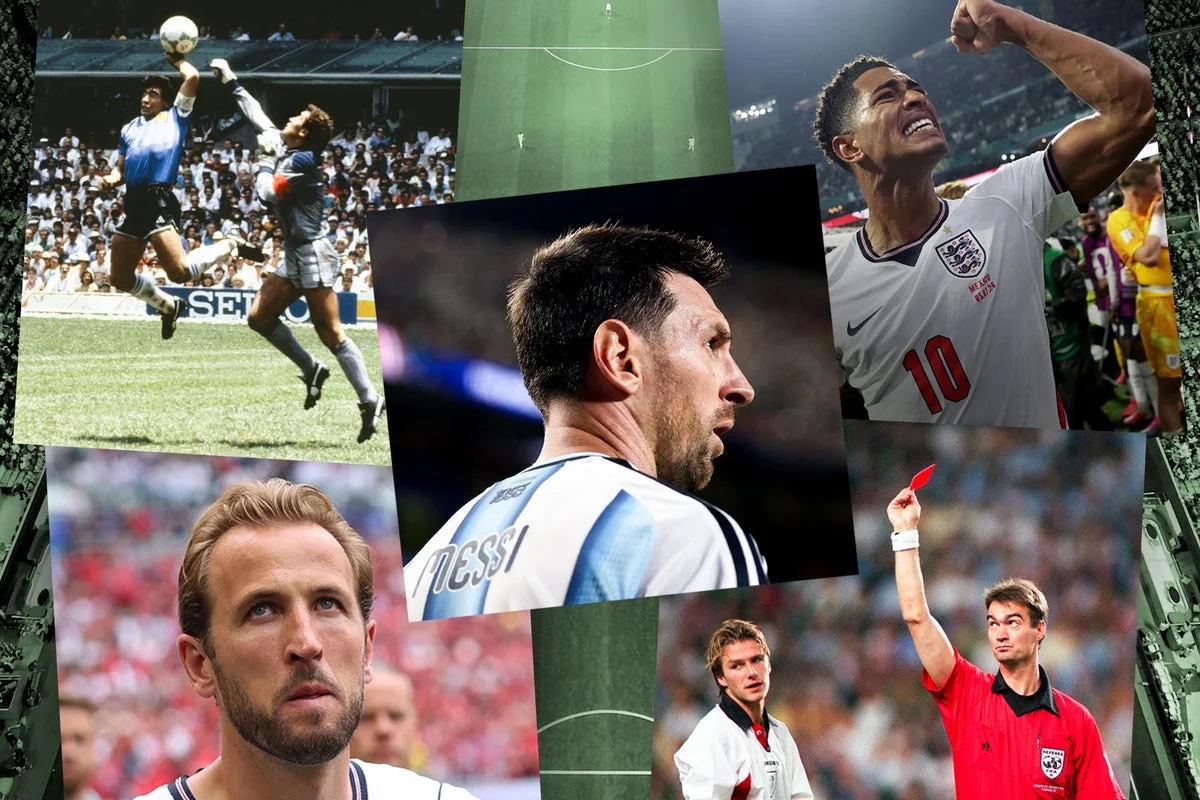
England vs Argentina: The History Behind Football’s Most Charged Rivalry
Tension emerged the moment England and Argentina confirmed their latest meeting, reflecting a long-standing clash of perspectives.
Argentina manager Lionel Scaloni immediately insisted, “This is a football game, and that is all.” Yet, at that same moment, his players were singing in the dressing room about winning “for Las Malvinas.”
This atmosphere mirrors the “Muchachos” song that soundtracked the 2022 World Cup, which includes a direct mention of “the kids of Malvinas, that we’ll never forget.”
“You can feel it,” Javier Zanetti said in a documentary about the 1998 last-16 tie. Diego Simeone added that the fixture is “not related to football, but there’s something different about it.”
This is a true World Cup epic, and few fixtures compare. While Brazil-Italy offers football history and Brazil-Argentina happens regularly, England-Argentina carries a unique weight. Not even England-Germany matches the intensity, as that rivalry can also occur in the European Championship. It is impossible not to be excited about the upcoming match in Atlanta, where the sport is invigorated by so much more than tactics.
If real history fueled the initial meetings, the matches themselves created a legacy of their own. The 1986 quarter-final at the Azteca remains the centerpiece of World Cup lore and its most famous match.
The shadow of Diego Maradona’s ‘Hand of God’ looms over England vs Argentina (Bob Thomas/Getty)
Diego Huerta, a football executive who oversaw Racing’s 2019 Argentine title win, describes that match as “the most important of my life – more than the World Cup finals.” He notes that if Diego Maradona had scored those goals against Belgium instead, it would not carry the same significance.
England has already played at the Azteca during this tournament, bringing past memories to the fore. Jude Bellingham scored twice in that same end.
On Saturday, prior to both sides reaching the semi-finals, Antonio Rattin died. He was the central figure of the 1966 quarter-final, which provoked Sir Alf Ramsey to label the Argentina side “animals.”
By that same evening, Simeone and David Beckham—the key figures of the 1998 clash—were embracing for a photo. However, other emotions have strengthened rather than subsided. Mentions of the 1982 Falklands War appear more frequently now than in 1998, driven by social media, nationalist sentiment, and a global rightward political shift reflected by Argentine president Javier Milei. The islands have returned to the political agenda as oil drilling operations are set to proceed.
For the players, the rivalry remains visceral. Maradona explained in his book, Touched by God, how the 1986 team viewed the match as a response to the war, where young conscripts were sent to fight. That sentiment remains, as the current generation carries memories of the 649 who died and the 1,082 who were injured.
The Falklands war still plays a huge role in the Argentine national consciousness (AFP/Getty)
Irish writer Paul Howard describes the Argentine graveyard on the islands as “one of the saddest places you can visit.” Crosses for 15-year-old conscripts are draped in shirts of Argentina, Boca Juniors, and River Plate.
Maradona once described the goal of beating England as “like forcing them to surrender.” He felt the handball—his “Hand of God”—was a way to provide consolation to families of those lost. While the handball created a sense of grievance for England, Maradona ironically respected the English for their “noble and honest” conduct on the field during that 1986 match.
This history continues to shape the modern game. As Argentina prepares for the semi-final, forward Jose Lopez stated the team’s intention to “leave our lives on the field.”
Whether England can tap into a similar depth of emotion remains the question. Argentina plays on emotion, but England carries the weight of seeking a first World Cup final in 60 years. Ultimately, it remains “a football game,” but one defined by so much more.