
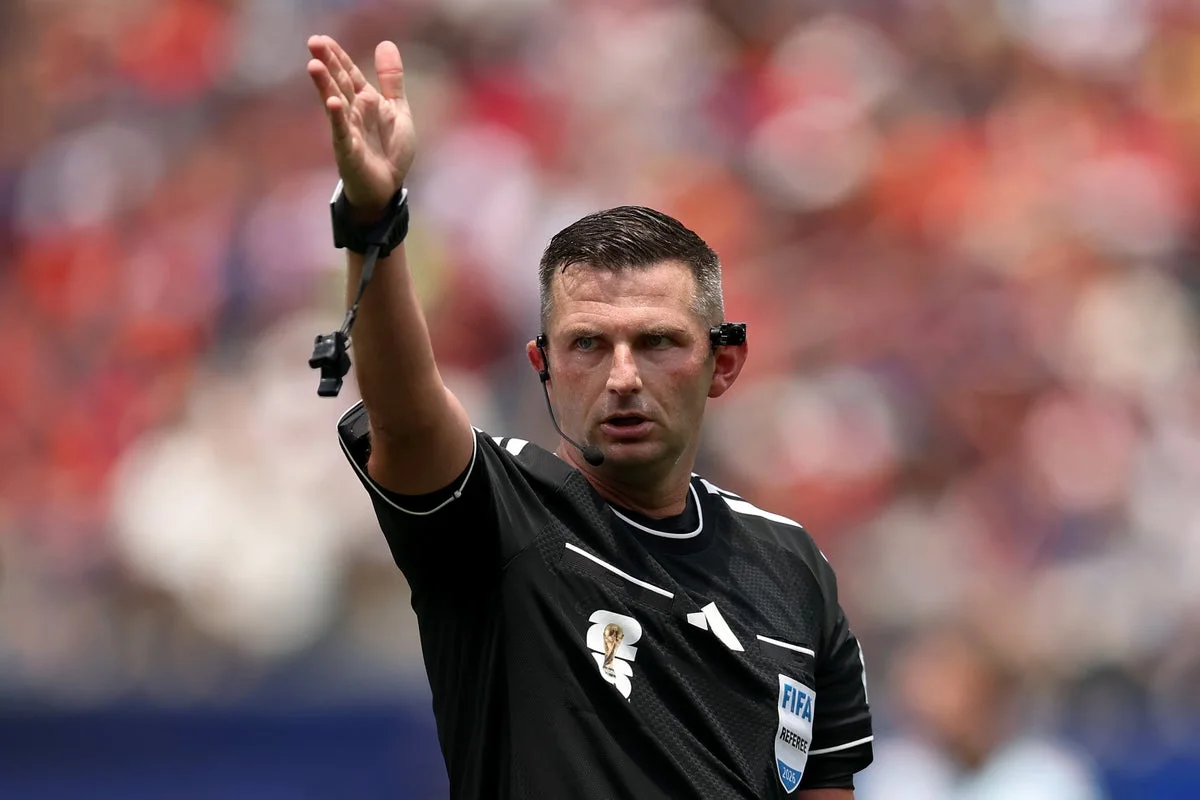
How FIFA Selects Referees for the World Cup 2026
With the World Cup 2026 reaching its final stages, observers are scrutinizing more than just player performances.
The appointment of referees has sparked significant conversation, particularly after officials announced an all-Argentine line-up for France’s 2-0 win against Morocco on Thursday evening.
Many fans online questioned this selection, noting the possibility that favorites France could face defending champions Argentina in the final, repeating the 2022 showpiece match.
Fifa also confirmed that English referees Anthony Taylor and Michael Oliver could not officiate Argentina matches due to the Falklands War, which took place 44 years ago.
Here is a Q&A on how Fifa appoints their referees for the World Cup.
What are the main factors at play?
The primary factor determining a referee appointment at the World Cup is their collective performance, as officials typically work with two assistant referees throughout the tournament.
The Fifa Referees Committee, chaired by former World Cup final official Pierluigi Collina, manages a multi-year monitoring process to select these pairings.
While match form and decision-making remain the core requirements, geo-political factors also influence assignments.
Referees cannot officiate matches involving their own country. Furthermore, Fifa confirmed to The Independent that they do not assign a referee to a game if the result holds a direct consequence for that official’s home nation.
For instance, an English referee would not officiate a non-England match in their group, such as Panama vs Croatia. Additionally, an English referee could not have taken charge of Argentina vs Switzerland, because the winner could face England in the semi-finals.
This policy generally focuses on “next-match” implications. This explains why an all-Argentine team officiated France’s 2-0 quarter-final win over Morocco, despite Argentina being a potential opponent in the final.
Fifa prefers to appoint officials from a neutral confederation. If an African team plays a South American nation, a European referee may be selected. If two European teams play each other, such as Spain’s quarter-final against Belgium, a European referee like Michael Oliver remains an option.
Other geo-political reasons also apply. An American official would not referee an Iran match, for example, due to the ongoing conflict between the two countries.
While no formal rule exists, Fifa utilizes common sense and monitors politically sensitive situations. A source described the process as “quite fluid”.
Is the Falklands War a factor?
A Fifa spokesperson confirmed that the 1982 Falklands War remains a factor in appointments. Consequently, no English official will work an Argentina match, or a game with a direct consequence for Argentina, and vice-versa.
This restriction prevents an English referee from officiating the final, given that England and Argentina are set to face each other in the semi-finals.
The conflict remains a sensitive topic, especially after Argentina players sang “Muchachos,” which references the “Malvinas”—the Argentine name for the islands—following their win against Egypt.
Older conflicts, such as the Second World War, do not affect current assignments; therefore, a German referee could manage an England match.
Have there been any exceptions to this rule?
Exceptions have occurred.
Argentine referee Horacio Elizondo oversaw England’s 2006 quarter-final defeat to Portugal, a match remembered for Wayne Rooney’s controversial red card following an incident with Ricardo Carvalho.
Fifa could not confirm why their current guidance regarding the Falklands War was not applied 20 years ago.