
Belgium’s evolving squad eyes World Cup glory as veterans take new lead
When the World Cup began 30 days ago, few observers believed Belgium—lacking many of the star names from their previous campaigns—ranked among the potential winners.
Even fewer believed in their chances when they trailed 2-0 with 85 minutes played against Senegal in the round of 32.
Now, the Red Devils are in the quarter-finals. They delivered a legendary comeback to defeat the Senegalese before following that success with one of the tournament’s most impressive displays in a 4-1 victory over the USA on American soil.
While icons like Eden Hazard, Mousa Dembele, Marouane Fellaini, and Vincent Kompany have moved on, a squad featuring Thibaut Courtois, Romelu Lukaku, Kevin de Bruyne, and Axel Witsel has transformed a mediocre start into a legitimate shot at glory.
As the team prepares to face Spain for a semi-final spot this Friday, questions remain: was this golden generation written off too early, or is manager Rudi Garcia harnessing their talents in a different way?
How crucial have golden generation survivors been for Belgium?
Belgium reached the quarter-finals in 2014 and the semi-finals in 2018, but the team performed poorly in 2022, suffering elimination in the group stage.
“I think this is a new era for us,” said Real Madrid goalkeeper Courtois, who is playing in his fourth World Cup. “It is true that some players from the golden era remain, but the World Cup in Qatar was not that good for us.”
“Now we have another generation with younger people, new people, willing to do great things and write new history for Belgium.”
Of the four survivors from 2014 and 2018, 34-year-old Courtois has played every minute, while De Bruyne, Lukaku, and Witsel have seen reduced roles.
Witsel, 37, entered for only a single minute against the USA. Lukaku, 33, has scored three goals despite playing fewer than 50% of the available minutes, often utilizing his fresh legs against fatigued defenses pressured by 25-year-old Charles De Ketelaere.
De Bruyne, 35, suffered an injury during the Senegal match. Since then, Belgium has secured two victories and scored seven goals in roughly 130 minutes of play.
While senior players still contribute significantly, their role is changing; the squad now relies on them for key individual moments rather than overall match control.
Who has stepped up for Belgium?
Manager Rudi Garcia rejects the focus on age. “I really can’t stand it when my four leaders are called ‘veterans’,” he stated. “It is ugly. It is awful.”
“If you are lucky enough as a country to have players of this calibre, then encourage them.”
Strong performances from younger players have bolstered the squad. Arsenal’s Leandro Trossard leads the tournament with 17 created chances, adding two goals and two assists. De Ketelaere has contributed two goals and one assist, while captain Youri Tielemans netted both the equalizer and winner against Senegal.
Communication key for Lukaku and colleagues
The squad gained momentum following a controversy involving a FIFA decision to suspend USA striker Folarin Balogun. The players mocked the situation on the pitch, and Garcia later praised the unity of his group, noting: “The group is very mature. We have leaders to help us.”
Managing this group requires navigating language diversity, as the squad includes players from various cultural backgrounds. English serves as the team’s neutral language.

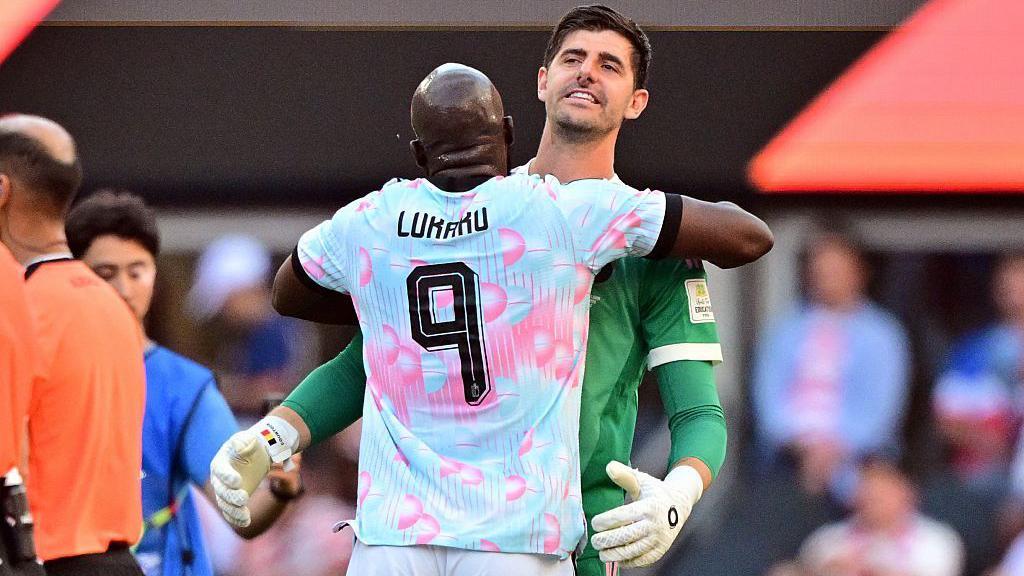
Romelu Lukaku has scored 93 goals in 131 appearances for Belgium since making his debut in 2010, and takes on a key leadership role in the squad [Getty Images]
“English becomes very useful—you can avoid those issues and it all becomes neutral,” explains Dr. Jim Ureel, a lecturer in applied linguistics at the University of Antwerp. “I think it’s very clever how they do it.”
Moving forward, Belgium relies on a core of seasoned professionals taking on paternal roles, guiding their teammates toward a future where the next generation will soon take the lead.